Monthly Archive May 24, 2026

ByDavid Adamson

Top Websites That Show Up in ChatGPT Results (Updated June 2026)

When you ask ChatGPT a question, it often pulls information from websites and mentions them in its answer. But which websites does it use the most?

Coin Ideology Digital teams studied the following key sources to find out the top website that show up in ChatGPT result. This blog brings together all that data in one easy-to-read place.

Key sources used:

  • Ahrefs — studied 9.6 million ChatGPT queries (Sep 2025)
  • Profound — analyzed 680 million citations (Jun 2025)
  • First Page Sage — ran 36,127 buying-focused questions (Dec 2025, updated Apr 2026)
  • BuzzStream — cross-study comparison of all major reports (Apr 2026)
  • SEMrush AI Visibility Index — industry-specific breakdown (Sep 2025)

Important: The results look very different depending on the TYPE of question asked. A general question gives very different results from a buying-focused question. Keep that in mind as you read.

Top 15 Most Cited Websites in ChatGPT (US Data)

Based on Ahrefs’ study of 9.6 million queries — the largest study available — here are the top websites ChatGPT mentions most in the United States.

#WebsiteMentions (US)CategoryKey Note
1reddit.com847,338Community / Forum~30% of all US citations
2en.wikipedia.org431,710Reference / Knowledge7.8% of all global citations (Profound)
3amazon.com97,457eCommerceTop product source
4forbes.com48,052Media / BusinessAppears in ALL 4 major studies
5businessinsider.com37,712Media / BusinessStrong across all topics
6thespruce.com36,195Home & GardenLeading home authority
7wired.com28,611TechnologyTop tech & science pub
8techradar.com28,363TechnologyAppears in 3 of 4 studies
9tomsguide.com26,863Tech ReviewsGadgets & buying guides
10verywellhealth.com25,091HealthTop trusted health site
11healthline.com22,865HealthGlobally trusted wellness
12theguardian.com21,602NewsMajor international news
13investopedia.com20,218FinanceGo-to financial knowledge
14nerdwallet.com16,525FinanceTop personal finance site
15consumerreports.org12,923ReviewsIndependent product testing

Why is Reddit #1? In March 2024, Reddit signed an official data partnership with OpenAI. This gives ChatGPT direct access to Reddit’s real-time content — which is why Reddit alone makes up almost 30% of all US citations.

Sites That Show Up Across Every Study

Different research teams used different methods, so raw numbers vary. But some sites show up on every list. These are the true ‘always cited‘ websites.

WebsiteAppears InWhy It Matters
forbes.com4 / 4The most consistent publisher. Shows up in every major study.
reddit.com3 / 4Dominates when it appears. Has an official OpenAI data partnership.
wikipedia.org3 / 4Accounts for 7.8% of all 680M citations in Profound’s study.
techradar.com3 / 4A surprising consistent performer across tech and business topics.
businessinsider.com3 / 4Strong presence across business, tech, and lifestyle queries.

Forbes is the only website that appeared in all 4 major studies — making it the single most consistent publisher for ChatGPT citations. If you want to get featured somewhere to improve your AI visibility, Forbes is your best bet.

When Someone Wants to Buy — Different Sites Win

Here is a very important finding from First Page Sage’s study of 36,127 buying-focused questions. When someone asks ChatGPT ‘what is the best product?’ or ‘which service should I hire?’, different types of websites get cited.

Reddit drops way down the list. Instead, product review sites and consumer platforms take the top spots.

#Website TypeCitationsExamples
1Product Recommendation Sites7,642Wirecutter, Tom’s Guide, TechRadar — ‘Best of’ review sites
2Consumer Review Platforms5,983Trustpilot, BBB, Google Reviews
3Traditional Media4,581Forbes, NYT, Wired — major publishers
4Digital-Native Publications3,826TechCrunch, The Verge
5YouTube / Video Reviews3,211Video reviews AI can summarize
6Directory Sites2,639Yelp, TripAdvisor, Angi
7Official Brand Sites2,208Manufacturer or retailer sites
8B2B Marketplace Directories1,762G2, Clutch, UpCity
9eCommerce Marketplaces1,413Amazon, Walmart, Best Buy
10Corporate Blogs1,109HubSpot Blog, Salesforce Newsroom
12Forum Communities (Reddit etc.)674Much lower for buying queries

Bottom line for buying queries: If you sell a product or service, focus on getting listed in ‘best of’ roundups (like Wirecutter or Tom’s Guide), review platforms (Trustpilot, BBB), and major media like Forbes. Reddit is great for awareness but has very little impact on commercial recommendations — only about 11% influence.

Top Sites by Industry (Buying Queries)

The sites ChatGPT cites change a lot depending on your industry. Based on First Page Sage’s research of 36,127 buying-intent queries across 18 industries:

IndustryTop-Cited Websites by ChatGPT
eCommerceWirecutter, Forbes, Tom’s Guide
Financial ServicesNerdWallet, Investopedia, Forbes Advisor
HealthcareForbes Health, Verywell Health, Medical News Today
AutomotiveCar and Driver, Kelley Blue Book, Edmunds
Home ServicesAngi (Angie’s List), Thumbtack, HomeAdvisor
SaaS / SoftwareG2, DesignRush, Clutch
HospitalityTripAdvisor, Booking.com, Yelp
CybersecurityCybersecurity Insiders, Gartner Peer Insights, TechRadar
PharmaceuticalDrugs.com, FDA.gov, PubMed
Real EstateZillow, Realtor.com, Redfin
Higher EducationUS News Education, Niche.com
ManufacturingThomasnet, IndustryWeek, Engineering360

Key Takeaways — What This Means For You

1. Reddit and Wikipedia Dominate — But Not Everywhere

These two sites come out on top in almost every general study. But for commercial or buying queries, their influence is much smaller. Don’t assume Reddit is the most important thing to focus on for business growth.

2. Getting Listed in ‘Best Of’ Articles Is Very Powerful

Product recommendation sites (Wirecutter, Tom’s Guide, TechRadar) are the #1 type of site cited for buying queries. If you want ChatGPT to recommend your product or service, getting featured in these roundups is where to focus your PR efforts.

3. Reviews Matter a Lot

Consumer review platforms (Trustpilot, BBB, G2) are the 2nd most-cited type for buying queries. Maintaining a strong review presence on these sites directly affects whether ChatGPT recommends you.

4. Forbes Is the Safest Publication to Target

Forbes is the only site that appeared across all 4 major studies. Getting featured in Forbes — or similar high-authority publications — gives you the best chance of showing up in ChatGPT answers across many different types of questions.

5. OpenAI Partnerships Don’t Guarantee Visibility

Of 17 confirmed OpenAI data partners, only 8 showed up in the top 10 of any study. Having a partnership with OpenAI does not automatically mean ChatGPT will cite you more. Good content and domain authority matter more.

6. Your Industry Changes Everything

The sites ChatGPT uses change completely by topic. A healthcare brand should target Verywell Health; an automotive brand should target Edmunds. Always look at your specific industry, not just the overall top 10 list.

7. Good Old SEO Fundamentals Still Apply

The sites ChatGPT trusts most all share the same traits: high domain authority, topical expertise, and strong brand recognition. There is no trick or shortcut — strong content and a trusted brand are what get you cited by AI.

Data Sources

  • Ahrefs — ‘100 Most Cited Domains in ChatGPT’ — Sep 2025 — 9.6M queries
  • Profound — ‘AI Platform Citation Patterns’ — Jun 2025 — 680M citations
  • Wellows — ‘ChatGPT Citations Report’ — Jul 2025 — 485K citations
  • SEMrush AI Visibility Index — Sep 2025 — 5 major industries
  • First Page Sage — ‘Most Cited Websites by AI for Buying-Intent Queries’ — Dec 2025, updated Apr 2026 — 36,127 queries
  • BuzzStream — ‘Top Sites Showing Up in ChatGPT’ — Apr 2026 — cross-study analysis

ByDavid Adamson

How to Rank YouTube Videos on Google AI Overviews

Google is pulling more YouTube videos into search results and AI overviews than ever before. If you follow these 3 steps, you can tap into a stream of free, consistent search traffic — even if you’re not a big creator yet.

Coin Ideology Digital is the SEO and digital marketing agency that help its client’ website and Youtube videos to rank on Google AI Overviews.

Why YouTube Videos Now Show Up in Google (And AI)

Here’s something most people miss: Google doesn’t just show blue links anymore. It shows videos, and — more importantly — it shows AI-generated answers that pull content directly from YouTube.

That means a YouTube video you make today can appear in Google search results and inside an AI overview. You’re not competing for one spot. You’re competing for two.

The good news? Most of your competitors have no idea this is happening. They’re still chasing viral hits and subscriber counts. You’re going to play a smarter game.

STEP 1: Find Topics People Actually Search For (Not Just Viral Ideas)

Most creators chase videos that go viral. And hey, viral is great — when it happens. But here’s the problem: viral traffic disappears in 48 hours.

Search traffic? That can keep coming in for years.

The key idea here is the difference between a “social hit” and a “search hit.”

TypeExample TopicTraffic PatternLifespanBest For
Social Hit“I tried eating only pizza for 30 days”Spike then crash48-72 hoursGoing viral
Search Hit“How to tie a tie for beginners”Steady and growingYearsConsistent traffic
Mixed“Best protein powder 2025”Seasonal + steady6-12 monthsBoth audiences

How to Find Search-Driven Topics:

  • Type keywords into YouTube’s search bar and look at the autocomplete suggestions — those are real searches people do.
  • Use Google’s “People Also Ask” box to find questions your audience is asking.
  • Check tools like TubeBuddy or vidIQ to see monthly search volumes for YouTube keywords.
  • Look at what already ranks on Google with a video result — that’s your signal that Google wants video for that topic.

STEP 2: Optimize Your Video So Google Can’t Ignore It

You found a great topic. Now you need Google to understand what your video is about. This is where most people drop the ball — they upload a great video with a vague title and zero description.

Don’t do that. Here’s the full checklist:

1. Use Your Target Keyword in the Title.  Put the exact search phrase people type into Google right in your video title. Don’t try to be clever or creative here — save that for your thumbnail. If someone searches “how to make sourdough bread,” your title should say “How to Make Sourdough Bread” — not “My Crusty Morning Ritual.”

2. Write a Real Video Description.  The description isn’t just a place to paste your links. Write 2-3 sentences that clearly explain what the video covers. Put your target keyword in the first two lines — Google reads those first.

3. Add Timestamps to Create Chapters.  When you add timestamps (like “0:00 Intro, 1:30 Step 1, 3:00 Step 2”), YouTube and Google can surface the exact part of your video for very specific queries. You can rank for multiple keywords with one video.

4. Say Your Keyword Out Loud in the Video.  Google’s AI can now listen to your video and understand what it’s about. So if your target keyword is “how to fix a leaky faucet,” say those words clearly in your video — especially in the first 30 seconds.

5. Match What the Top Results Are Doing.  Before you hit record, search your target keyword on Google and YouTube. Are the top results tutorials? Listicles? Product reviews? Match that format. If Google loves listicles for your keyword and you make a vlog, you’re fighting uphill.

Format Matching: What Type of Video Should You Make?

Keyword TypeExampleBest Video FormatWhy It Works
How-to“How to change a tire”Step-by-step tutorialMatches problem-solving intent
Best of“Best budget laptops 2025”Listicle / RoundupMatches comparison intent
Review“iPhone 16 review”First-person review with demoMatches evaluation intent
Beginner topic“What is SEO”Explainer / OverviewMatches learning intent

Pro Tip: Don’t just look at the top YouTube results. Search the keyword on Google itself. If Google shows a video carousel, that’s your green light. If it doesn’t — that keyword might just not be a “video keyword,” and you might get better ROI making a blog post instead.

STEP 3: Claim Your Spot in AI Overviews Before Your Competitors Wake Up

This is the newest opportunity — and the most underrated one right now.

Google’s AI overviews (the AI-generated summaries at the top of some search results) are increasingly pulling content from YouTube. Google’s AI uses YouTube videos as source material. That means a YouTube video that answers a question well can literally be cited inside an AI answer.

Think about what that means. Instead of just appearing in the video carousel, your video could be the source the AI quotes. That’s next-level visibility.

How to Find AI Overview Opportunities

Not every search triggers an AI overview. But many do — and you need to find which ones in your niche are already citing YouTube.

What to Look ForWhat It MeansYour Move
AI overview already shows YouTube linksGoogle wants video content for this topicMake a comprehensive video targeting this exact query
AI overview exists but no YouTube links yetOpportunity to be the first video sourceCreate a video more thorough than what currently ranks
No AI overview yet, but “People Also Ask” questions existTopic is growing — AI may show up soonGet in early while competition is low
Only text articles rank, no videosGap in video contentBe the first video creator to cover this topic well

What “Comprehensive” Actually Means

To get into AI overviews, your video needs to be thorough. AI systems are looking for content that fully answers a question — not just scratches the surface.

Weak Video (Won’t Get Cited)Strong Video (AI-Ready)
Covers the topic in 2-3 minutes, surface levelCovers the topic fully with subtopics and examples
No chapters or timestampsClear chapters that match common sub-questions
Vague script, no specific data or stepsSpecific, actionable steps with real examples
Target keyword mentioned once or not at allTarget keyword + related terms said naturally throughout
No description or a copy-pasted descriptionDetailed description with keyword in first two lines

Bottom Line: Most of your competitors are focused on subscriber growth and trending topics. They’re missing the “AI shelf space” that’s sitting wide open. If you get there first with a comprehensive, well-optimized video, you’re much harder to displace later.

The Full 3-Step Playbook at a Glance

StepWhat You DoGoalTime Investment
1 — FindResearch search-driven topics using autocomplete, Google, and keyword toolsPick topics with consistent long-term demand30-60 min per topic
2 — OptimizeUse keyword in title, description, timestamps, and spoken audio. Match search intent.Make Google and AI understand your video1-2 hours per video
3 — AI VisibilityFind queries where AI overviews already cite YouTube. Create comprehensive videos for those queries.Get cited inside AI-generated answersOngoing research

Common Mistakes That Kill Your Rankings

MistakeWhy It HurtsFix It By…
Clever title with no keywordGoogle can’t understand what your video is aboutLead with the keyword, get creative with the thumbnail instead
Empty or link-only descriptionYou’re leaving SEO signals on the tableWrite 3-5 sentences summarizing the video with the keyword up top
No timestampsGoogle can’t surface specific video sections for long-tail queriesAdd chapters every 1-2 minutes with descriptive labels
Never saying your keyword out loudAI audio processing can’t confirm your topicSay the keyword clearly in the first 60 seconds of the video
Wrong format for the intentYour video doesn’t match what searchers expectCheck the top results before filming and match their format
Ignoring AI overview opportunitiesYou miss a fast-growing traffic sourceSpend 30 minutes a week checking which queries trigger AI overviews in your niche

Start With One Video This Week

You don’t need a big channel to make this work. Pick one search-driven topic, optimize the video using the checklist above, and look for AI overview opportunities in your niche. The creators who figure this out now will have a massive head start.

The AI shelf space is wide open. Go claim yours.

Ready to rank Youtube Video on Google AI Overview? Let’s make it happen.

If you are interested to promote your project with us then please leave a message at coinideology@gmail.com or add us on skype : live:coinideology or Telegram: @coinideology

ByDavid Adamson

How To Get Your Brand Cited in AI Search Results (3 AEO Strategy)

If you want to learn how to get your brand cited in AI search results then you have come to the right place.

Coin Ideology Digital is the SEO and digital marketing agency that help its clients brand cited in AI search results.

Meanwhile, a completely different metric is quietly deciding who shows up in AI-generated answers.

It’s not your domain rating. It’s not your backlink count.

It’s branded web mentions.

Here’s the thing: brands with strong mention signals across the web are getting cited in Google’s AI Overviews and ChatGPT results — even when their traditional SEO metrics are average at best.

In this guide, I’m going to break down the exact three-tier system for building the kind of brand presence that AI models love to cite.

Let’s go.

Why Branded Mentions Beat Traditional SEO Metrics

This is the insight that changes everything.

AI models don’t just crawl backlink graphs. They read the web the way a human researcher would. They look for brands that appear repeatedly — in credible places, in positive contexts, across different types of sources.

That’s what a branded web mention is. Your brand name showing up in a real editorial context.

And the data backs this up: branded web mentions correlate more strongly with AI visibility than domain rating or backlink count.

Think about what this means.

A scrappy brand with 200 high-quality mentions across Reddit, industry publications, and niche forums can outperform a competitor with 10,000 backlinks — in AI results.

That’s a massive opportunity. Here’s how to seize it.

The Three AEO Brand Mention System

Not all mentions are created equal.

AI models weigh mentions differently based on where they appear. So your strategy needs to match that hierarchy.

Here’s the full breakdown.

Tier 1: Third-Party Editorial Content

This is the gold standard. The hardest to earn. The most valuable to have.

Tier 1 mentions come from:

  • Industry publications (trade blogs, niche media outlets)
  • Review sites (G2, Capterra, Trustpilot, etc.)
  • Comparison and listicle posts (e.g., “10 Best CRM Tools for Startups”)

Here’s why Tier 1 matters so much: AI models pull heavily from these sources. In fact, 43.8% of ChatGPT citations come from third-party editorial content.

That stat is staggering. Nearly half of all AI citations come from sources you don’t control.

Which means getting into those sources isn’t a nice-to-have. It’s a core strategy.

How to earn Tier 1 mentions:

  • Build relationships with journalists and editors in your niche
  • Create original data and studies that publications want to reference
  • Reach out to existing comparison posts and ask to be included (if you genuinely belong)
  • Get reviewed on the major review platforms in your category
  • Pitch guest posts to industry publications with real insight — not promotional fluff

The key word is “earn.” AI can tell the difference between authentic editorial mentions and paid placements stuffed with keywords. Focus on genuine coverage.

Tier 2: User-Generated Content and Communities

This tier surprises a lot of people.

Reddit. Quora. Niche forums. Discord servers. These aren’t just traffic channels. They’re foundational training data for AI models.

When someone asks an AI “what’s the best tool for X,” the AI has likely been trained on thousands of Reddit threads, Quora answers, and forum discussions where real people gave real opinions.

That means your brand presence in these communities directly influences AI-generated recommendations.

The right way to do this:

Participate. Don’t spam.

Find the subreddits, Quora spaces, and forums where your target audience lives. Answer questions where you genuinely have expertise. Add real value. Mention your brand where it’s relevant and natural — not in every single response.

This approach builds something AI can recognize: consistent, community-validated brand credibility.

What not to do:

Don’t create fake accounts. Don’t flood threads with promotional comments. Don’t post the same answer across 50 subreddits.

AI models are trained to recognize authentic signals. Low-quality, repetitive mentions don’t just fail to help — they can actively work against you.

Tier 3: Your Own Properties

You can’t control Tier 1 or Tier 2. But Tier 3 is 100% in your hands.

Your own properties include:

  • Your website and blog — the most obvious, but still critical
  • YouTube channel — AI increasingly references video content
  • Podcast — each episode is another indexed piece of brand content
  • LinkedIn — both your company page and personal posts from your team

Here’s the strategic goal with Tier 3: create consistent, positive, topically relevant signals across multiple properties.

AI models build a picture of your brand based on everything they can find. The more consistently that picture says “this brand is a credible expert in [topic],” the more likely you are to get cited.

Practical steps:

  • Publish regular content on your blog that addresses the specific questions your audience asks
  • Create YouTube videos that answer those same questions in a different format
  • Have your leadership team post thought leadership on LinkedIn
  • Start a podcast if your niche supports it — it’s a massive underutilized signal

The goal isn’t to be everywhere. It’s to have enough consistent, quality signals that AI models can confidently attribute expertise to your brand.

TierSourcesWhy AI values itHow to earn itDifficulty
Tier 1: Third-party editorialIndustry publications, review sites (G2, Capterra), comparison posts, listicles43.8% of ChatGPT citations come from these sources. Highest credibility signal for AI models.Pitch original researchRequest inclusion in comparison postsBuild journalist relationshipsGet listed on review platformsHard
Tier 2: User-generated contentReddit, Quora, niche forums, Discord communitiesFoundational AI training data. Real user endorsements signal authentic brand credibility.Participate — don’t spamAnswer questions with real expertiseMention brand only when naturalFocus on the right communitiesMedium
Tier 3: Owned propertiesWebsite/blog, YouTube, podcast, LinkedIn (company + personal)Creates consistent, topically relevant signals AI can find across multiple indexed sources.Publish consistently on each channelAnswer questions your audience searchesAlign messaging across all propertiesHave leadership post thought leadershipLow

How To Monitor and Maintain Your Brand Mentions

Building mentions is step one. Protecting them is step two.

Here’s the thing most brands ignore: AI can cement wrong information about your brand into its training — and that’s very hard to undo.

Which is why monitoring matters.

Set up a regular mention audit using a tool like Brand Radar. Look for:

  • Drops in mention volume (you’re losing ground)
  • Sentiment shifts (positive mentions turning negative)
  • Misinformation (wrong facts, incorrect product descriptions, outdated pricing)

What to do when you find misinformation:

  1. Update your own authoritative content first. Make your official properties the clearest, most accurate source on the topic.
  2. Reach out to the publisher of the incorrect content and request a correction.

Do step one before step two. Always.

Why? Because if you contact the publisher first and they’re slow to update, AI models may continue pulling from the wrong source. If your own content is already updated, at least there’s a correct version available for AI to reference.

Speed matters here. The longer misinformation stays uncorrected, the deeper it gets embedded into AI training cycles.

What to monitorWarning signWhat to doSpeed
Mention volumeSignificant drop in how often your brand is mentioned across the webIncrease activity in Tier 2 communities. Ramp up Tier 3 publishing. Chase Tier 1 placements.Monthly
Sentiment shiftsPositive mentions trending negative in communities or reviewsIdentify the root cause. Address the product/service issue first. Then respond publicly where appropriate.Fast
MisinformationIncorrect facts, outdated info, or wrong descriptions of your brand online1. Update your own authoritative content first. 2. Contact publisher to request a correction.Urgent

Putting It All Together: Your Brand Mention Action Plan

Here’s the sequence that makes sense for most brands:

Month 1 — Audit and foundations

  • Run a full brand mention audit (volume, sentiment, accuracy)
  • Identify your top Tier 2 communities (subreddits, Quora spaces, forums)
  • Ensure your Tier 3 properties are consistent and up to date

Month 2 — Build community presence

  • Start participating in Tier 2 communities authentically
  • Answer 3–5 questions per week where you can genuinely help
  • Set up mention monitoring alerts for your brand name

Month 3+ — Earn Tier 1 coverage

  • Identify the top 10 comparison/listicle posts in your category
  • Check which ones don’t include you and reach out to the authors
  • Begin creating original research or data that journalists can cite
  • Build relationships with 2–3 editors at industry publications

Ongoing

  • Review mention volume and sentiment monthly
  • Fix misinformation fast — own properties first, then publisher outreach
  • Keep Tier 3 content publishing consistently
PhaseFocusKey actionsTier
Month 1Audit and foundationsRun brand mention audit. Check volume, sentiment, accuracy. Clean up Tier 3 properties. Set up monitoring alerts.Tier 3
Month 2Community presenceIdentify top Tier 2 communities. Answer 3–5 questions per week with real expertise. Build authentic participation habit.Tier 2
Month 3+Editorial coverageFind top 10 comparison posts in your category. Reach out for inclusion. Create original research. Build journalist relationships.Tier 1
OngoingMonitor and protectMonthly mention audit. Fix misinformation fast — own content first, then publisher outreach. Keep Tier 3 publishing consistently.All tiers

Final Thoughts

The brands winning in AI search right now aren’t necessarily the ones with the best backlinks.

They’re the ones with the broadest, most consistent, most credible presence across the web.

Tier 1 editorial coverage tells AI: “Credible sources trust this brand.” Tier 2 community presence tells AI: “Real people recommend this brand.” Tier 3 owned content tells AI: “This brand is the authority on this topic.”

Stack all three. Monitor and protect them. Correct mistakes fast.

Do that consistently and you won’t just appear in AI results — you’ll become the default recommendation.

That’s the game. And it’s just getting started.

Ready to get your brand into the AI search results? Let’s make it happen.

If you are interested to promote your project with us then please leave a message at coinideology@gmail.com or add us on skype : live:coinideology or Telegram: @coinideology

ByDavid Adamson

How To Optimize Content for AI Search Engines (The 2026 Guide)

If you are looking for how to optimize content for AI search engines in 2026 then you have come to the right place.

People are still obsessing over word count, keyword density, and backlink profiles — while completely ignoring the shift that’s already happening under their feet.

AI search engines are changing how content gets discovered, cited, and trusted.

And here’s the thing: the rules are different. Very different.

I recently dug into the data on what AI models actually cite. The results shocked me.

In this guide, I’m going to show you exactly what makes content AI-citation-worthy — plus the specific tactics you can start using today.

Let’s get into it.

What the Data Actually Says About AI Citations

Before we talk strategy, let’s look at what’s real.

Because a lot of what you’ve heard about “AI SEO” is guesswork. The stuff below is not.

Finding #1: Word Count Doesn’t Matter

Stop writing 3,000-word articles just to rank.

The data is clear: there is virtually zero correlation between word count and AI citations (correlation score: 0.04). That’s basically noise.

Here’s what’s wild: over half of all AI-cited pages are under 1,000 words.

That’s right. Short, focused content beats bloated walls of text — every single time.

The reason makes sense when you think about it. AI models don’t reward effort. They reward clarity. If your answer is clear in 600 words, adding 2,000 more words doesn’t help you. It hurts you.

The takeaway: Stop padding. Say what you mean. Then stop.

Finding #2: Freshness Is a Huge Signal

This one surprised me.

AI-cited content is dramatically fresher than traditional organic search results. We’re not talking slightly newer — we’re talking meaningfully newer.

Many of the top-cited pages were updated within the last 30 days.

Why does this matter? Because AI models are trying to give accurate answers. Stale content risks being wrong. Fresh content signals relevance and reliability.

This is a massive opportunity that most people are completely ignoring.

The takeaway: Updating old content isn’t just a traffic trick. It’s an AI citation strategy.

Finding #3: Format Is Everything

AI doesn’t just read your content. It parses it.

And certain formats get parsed — and cited — far more than others.

Here’s the breakdown of what performs best:

  • Listicles: 43.8% of all AI citations. Yes, almost half. Lists are easy to chunk, easy to extract, and easy to cite.
  • Data-driven articles with original stats. Numbers give AI something concrete to point to. Original data gives you a citation moat.
  • Comparison guides (X vs. Y). These answer high-intent questions in a format AI loves — structured, parallel, clear.

The takeaway: If your content isn’t structured, AI won’t know what to do with it.

FindingWhat the data saysWhat to doPriority
Word countVirtually zero correlation with AI citations (0.04). Over 50% of cited pages are under 1,000 words.Stop padding. Write concisely and stop when the answer is complete.High
FreshnessAI-cited content is significantly newer than organic results. Many top-cited pages updated within 30 days.Publish updates regularly. Refresh stale but authoritative pages.High
FormatListicles = 43.8% of citations. Data-driven articles and X vs. Y comparisons also perform strongly.Use lists, add original stats, create comparison guides.High

How To Structure Your Content for AI Optimization

Okay, now let’s talk tactics.

Knowing what AI favors is step one. Knowing how to implement it is where most people fall short.

Here are four structural principles that make a real difference.

Principle 1: Use BLUF — Bottom Line Up Front

Old-school writing puts the answer at the end.

AI-optimized writing puts the answer at the beginning.

BLUF stands for “Bottom Line Up Front.” It’s a military communication principle, and it’s exactly how you should structure every section of your content.

Here’s what BLUF looks like in practice:

Old way: “In today’s fast-paced digital environment, businesses need to consider many factors when choosing a CRM. There are dozens of options on the market, each with different features, pricing, and integrations. After reviewing all of them, we’ve concluded that…”

BLUF way: “HubSpot is the best CRM for small businesses. It’s free to start, integrates with Gmail, and has the best onboarding experience in its class. Here’s why…”

Why does this matter for AI? Because language models weight the beginning of a section more heavily than the end. If your answer is buried in paragraph four, AI might miss it entirely.

Lead with the answer. Explain after.

Principle 2: Write Atomic Content

This is one of my favorite concepts in AI optimization.

Atomic content means every H2 section in your article is completely self-contained.

No references to “as mentioned above.” No context that requires reading section three to understand section seven. Each chunk stands alone.

Here’s why this is critical: AI models break your content into chunks when they process it. If a chunk requires context from elsewhere to make sense, it becomes useless to the model.

Test your sections like this: Take any H2 section and imagine a stranger reading just that section. Do they get value? Do they understand it completely? If yes — it’s atomic. If no — rewrite it.

Atomic content also makes your writing cleaner for human readers. Win-win.

Principle 3: Use Entity-Rich Writing

AI doesn’t just read words. It maps relationships between concepts.

And the way you help it do that? By being specific.

Don’t say “a popular email marketing tool.” Say Mailchimp.

Don’t say “a major social platform.” Say LinkedIn.

Don’t say “a leading CRM.” Say Salesforce.

When you use specific brand names, product names, and clear concepts, you’re giving the AI a roadmap. It can understand what your content is about and how it connects to other knowledge it already has.

Vague language confuses AI. Specific language educates it.

The rule: If you can be specific, be specific.

Principle 4: Write Short, Declarative Sentences

This is the simplest principle. It’s also the one most people ignore.

One idea per sentence.

Short sentences. Direct sentences. No qualifying clauses stacked on top of each other.

AI models parse sentences. Long, complex sentences with multiple clauses introduce ambiguity. Ambiguity reduces citation probability.

And here’s the bonus: short sentences are better for human readers too. They’re easier to scan. Easier to understand. Easier to remember.

Bad: “While it may seem counterintuitive given that many marketers have traditionally prioritized long-form content as a signal of depth and expertise, recent data suggests that conciseness, when paired with clarity and specificity, may actually outperform longer formats in AI citation contexts.”

Good: “Long content doesn’t get cited more. Short, clear content does. The data proves it.”

See the difference?

PrincipleWhy it worksHow to apply itCategory
BLUFLLMs weight the start of each section more heavily. Burying the answer reduces citation probability.Lead every section with the direct answer. Explain and elaborate after.Structure
Atomic contentAI chunks content when processing. Sections that rely on outside context become useless when isolated.Make every H2 self-contained. Test: can a stranger understand it alone?Structure
Entity-rich writingSpecific names and brands help AI map relationships and understand what content is about.Use exact brand names, product names, and clear concepts — never vague placeholders.Language
Declarative sentencesShort, one-idea sentences reduce parsing ambiguity for both AI models and human readers.One idea per sentence. Break long clauses into separate sentences.Language

Advanced Strategies for AI Optimization

Once you’ve nailed the basics, these two strategies will separate you from everyone else.

Strategy 1: Brand Your Proprietary Ideas

Here’s a problem that almost no one is talking about.

When you write about a concept — even a unique one — AI tends to generalize it. It strips out your brand name and presents the idea as generic knowledge.

Your original “Client Conversion Framework” becomes just… “a conversion framework.”

That’s a problem. Because you lose credit, traffic, and brand association.

The fix: Name everything. Brand everything.

Don’t write about “a scoring matrix.” Write about the [YourBrand] Scoring Matrix.

Don’t describe “a content audit process.” Describe the [YourBrand] Content Audit Process.

When your brand name is baked into the concept itself, AI models have no choice but to cite you by name. The brand becomes part of the entity.

This is how you build a citation moat that’s genuinely hard to copy.

Strategy 2: Refresh Your Sleeper Pages

Most websites have hidden gold sitting on them.

I call these sleeper pages. Here’s how to find yours:

  1. Look for pages that have solid backlinks (authority)
  2. But have seen a drop in traffic over the past 6–12 months
  3. These pages are trusted — but stale

Here’s why this matters: AI systems reward freshness. A page with strong backlinks AND a recent update is incredibly powerful. You get the authority signal AND the freshness signal at the same time.

But — and this is important — don’t just change the date.

AI can tell the difference between a real update and a fake one. Add new data. Update outdated stats. Add a new section. Rewrite sections that no longer reflect current reality.

Meaningful updates, not cosmetic ones.

This is one of the highest-ROI tactics available right now. You’re not starting from scratch — you’re making already-trusted pages even better.

StrategyWhy it mattersStep-by-stepEffort
Brand proprietary ideasAI flattens unique concepts into generic knowledge. Named frameworks preserve brand attribution.Label every unique concept with your brand name (e.g. “[Brand] Scoring Matrix”). Make your name part of the entity.Low
Refresh sleeper pagesPages with backlinks but declining traffic carry authority. A real update adds the freshness signal on top.Find pages with strong backlinks + traffic drop. Rewrite 20–30% with new data, updated stats, and fresh examples.Medium

Putting It All Together: Your AI Optimization Checklist

Before you hit publish on your next piece of content, run through this:

Structure:

  • Does every section lead with the direct answer (BLUF)?
  • Can every H2 section be understood without reading the rest of the article?
  • Are you using specific brand names and entities instead of vague language?
  • Are your sentences short and declarative?

Format:

  • Is your content structured as a list, comparison, or data-driven piece?
  • Do you have original data or stats that AI can point to?
  • Are your H2 and H3 headers clear and descriptive?

Freshness:

  • When was this content last meaningfully updated?
  • Are all stats and examples current?
  • Have you made real changes — not just date edits?

Brand:

  • Have you named your unique frameworks and concepts?
  • Is your brand name embedded in your proprietary ideas?
AreaCheckQuick test
StructureEvery section leads with the direct answer (BLUF)Read only the first sentence of each H2 — does it answer the question?
StructureEvery H2 section is self-containedCopy one section into a blank doc. Does it make sense alone?
LanguageSpecific entities used throughout (brand names, products)Search for “a popular tool” or “a major platform” — replace every instance.
LanguageSentences are short and one-ideaFlag any sentence over 20 words. Break it in two.
FormatContent uses lists, comparisons, or original dataIs there at least one list or data point AI can directly cite?
FreshnessAll stats and examples are currentCheck every year and every stat — are they still accurate?
BrandUnique frameworks are named with your brandAny original concept without your brand name in it?

Final Thoughts

Here’s the honest truth about AI search optimization.

It’s not complicated. But it does require you to unlearn some old habits.

Forget about word count. Focus on clarity.

Forget about stuffing keywords. Focus on entity-rich specificity.

Forget about writing for algorithms. Write for a reader who wants one clear answer — fast.

Do that consistently, and AI search engines will start doing something remarkable: they’ll cite you as the source.

That’s the new first-page ranking. And it’s up for grabs right now.

Start with one page. Apply the BLUF principle. Make it atomic. Brand your ideas. Then update your best sleeper pages.

The brands that figure this out in the next 12 months will own their categories in AI search for years.

Don’t let that be someone else.

Ready to optimize your content for AI Engines? Let’s make it happen.

If you are interested to promote your project with us then please leave a message at coinideology@gmail.com or add us on skype : live:coinideology or Telegram: @coinideology

ByDavid Adamson

How AI Search Really Works — And How to Make Sure Your Brand Shows Up

You have probably noticed that when people search on ChatGPT, Perplexity, or Google AI, they get a direct answer instead of a list of links. But here is the big question — whose brand gets mentioned in those answers? And how can you make sure it is yours? Let’s break it down in simple terms.

1. How Does AI Actually Find Information?

AI tools get their information from two places:

  • Training Data — This is information the AI learned during its initial training. Think of it as a massive snapshot of the internet taken at a specific point in time. It does not change unless the AI is retrained.
  • Real-Time Retrieval (RAG) — When you ask a question, the AI also searches the web live using search APIs. This helps it give you fresh, up-to-date answers.

What does this mean for you? To appear in AI answers, your brand needs to be established enough to show up in training data AND have good enough content to be found in live searches. In other words, classic SEO still matters — but it is only half the battle.

2. What Is Query Fan-Out and Why Does It Matter?

Traditional search is simple: you type one keyword, you get one set of results. AI search is very different.

When someone asks an AI a question, the AI does not just run one search. It runs dozens of smaller, related searches behind the scenes. This is called query fan-out. For example, if someone asks “What is the best project management tool for small businesses?” the AI might internally search:

  • best project management software
  • project management tools for small teams
  • affordable project management apps
  • top-rated business productivity software
  • …and many more

The lesson here: do not just target one keyword. Cover your entire topic thoroughly. The more angles you address, the higher the chance the AI picks up your content in one of its many sub-searches.

3. Why Does AI Cite Some Brands and Not Others?

Here is something surprising: AI citations are not fixed. There is no “rank 1” position the way there is in Google Search. Instead, citations are probabilistic — meaning the AI picks sources based on a mix of factors, including a small element of randomness.

Three main things boost your chances of being cited:

  • Consensus — The more your brand is mentioned across different websites, the more the AI “trusts” it. Being talked about consistently is key.
  • Freshness — AI systems prefer newer content. Updating your articles regularly gives you a real edge.
  • Authority — Pages that already rank in the top 10 of Google Search have a big advantage. But even lower-ranking pages can get cited if they offer genuinely helpful, relevant content.

4. Not All AI Platforms Are the Same

This is where it gets really interesting. Different AI platforms have very different preferences for which sites they cite. Here is a quick breakdown:

Google AI Overviews

Prefers well-established, authoritative websites. Think encyclopedias, health sites, finance sites, and Google’s own products like YouTube.

ChatGPT

Heavily favors high-authority publishers and media outlets. Sites like Wikipedia, Forbes, Business Insider, and Wired have a strong presence here.

Perplexity

The most closely aligned with traditional Google Search rankings. About 28.6% of Perplexity’s citations come from pages already ranking in Google’s top 10.

Google AI Mode

Interestingly, despite being a Google product, Google AI Mode overlaps with Google AI Overviews only 13.7% of the time. It tends to pull more from social platforms and community sites like Quora.

Key insight: There is very little overlap between what these platforms cite. Only 14% of the top 50 cited domains appear across all platforms. This means you cannot rely on one strategy — you need to think about each platform separately.

5. The 3 Types of AI Visibility (And Which One Is Rarest)

Not all AI mentions are created equal. Here are the three ways a brand can show up in AI answers:

  • Cited and Linked — The AI includes a clickable link to your site. This is the gold standard, but it is also the rarest. On average, links appear in only about 28% of AI mentions.
  • Mentioned but Not Linked — The AI names your brand without a clickable link. This still works as a word-of-mouth recommendation and helps build brand recognition inside AI systems.
  • Not Visible at All — Your brand is left out of the conversation completely. Identifying these gaps is the first step to fixing them.

Here’s an encouraging finding from the data: unlinked mentions have a strong correlation (0.664) with future AI visibility. In plain English — the more AI systems see your brand associated with a topic, the more likely they are to start linking to you over time. Mentions matter, even without a link.

6. A Simple Strategy to Improve Your AI Visibility

So what should you actually do? Here are the key takeaways put into action:

  • Cover topics thoroughly, not just keywords — Write content that answers every angle of a topic, not just one search term. This helps you get picked up across multiple sub-queries.
  • Build brand mentions on authoritative sites — Get featured on well-known blogs, news sites, and platforms like YouTube and Reddit. These mentions carry weight with AI systems.
  • Keep your content fresh — Regularly update your most important pages so AI tools see you as a current, active source.
  • Prioritize based on where your audience is — Google AI features and ChatGPT carry the most traffic volume, so focus there first. Then expand to other platforms like Perplexity.
  • Track your AI visibility — Use tools like Ahrefs’ Brand Radar to see where your brand is being mentioned or cited across AI platforms, and identify gaps to address.

AI SEO Is Different, But Familiar

AI search is changing the game, but it has not thrown out the rulebook entirely. Strong content, consistent brand mentions, and genuine authority still win — they just need to work across more platforms now. The brands that will succeed in AI search are the ones that stop chasing single keywords and start building real authority across the web. Get mentioned. Stay fresh. Cover your topics completely. The AI will notice.

Coin Ideology Digital — AI-Powered Marketing That Gets You Found

The way people search online is changing fast. AI tools like ChatGPT, Perplexity, and Google AI are now answering questions directly — and if your brand is not showing up in those answers, you are missing out on a massive opportunity.

That is exactly where Coin Ideology Digital comes in.

We are an AI marketing agency built for the future of search. We help businesses get discovered, mentioned, and cited across all major AI platforms — not just traditional Google rankings.

What We Do for Your Business

We apply proven AI visibility strategies to your website and online presence, including:

  • AI Search Optimization (AEO) — We optimize your content so AI tools are more likely to mention and cite your brand when users ask relevant questions.
  • Topic Authority Building — We create thorough, well-structured content that covers your niche from every angle, increasing your chances of being picked up across AI sub-queries.
  • Brand Mention Campaigns — We place your brand consistently across authoritative websites, blogs, and platforms like Reddit and YouTube — the exact signals AI systems trust.
  • Content Freshness Management — We keep your pages updated regularly, because AI platforms strongly favor fresh, current content.
  • Multi-Platform Strategy — We tailor your approach for each platform — Google AI Overviews, ChatGPT, Perplexity, and more — because each one cites sources differently.

Why It Matters

AI citations are not random. They are earned through consistency, authority, and smart content strategy. Brands that build strong AI visibility today will dominate their niche tomorrow.

At Coin Ideology Digital, we bring the strategy, the tools, and the expertise to put your business in front of the right audience — wherever they are searching.

Ready to get your brand into the AI conversation? Let’s make it happen.

If you are interested to promote your project with us then please leave a message at coinideology@gmail.com or add us on skype : live:coinideology or Telegram: @coinideology

ByDavid Adamson

Top 10 Blockchain Companies in Jaipur You Should Know in 2026

Jaipur is no longer just known for its rich culture and history; in 2026, it is also making waves in the world of blockchain technology! 

As businesses are now shifting towards secure, transparent, and decentralized solutions, the demand for skilled blockchain development companies is also growing. From creating powerful smart contracts to developing advanced Web3 applications, these companies are helping all kinds of businesses to stay ahead in the digital era. 

But with so many companies’ options available, picking the right blockchain partner is quite difficult, isn’t it? So, to help you out, in this guide, we will discover the list of the top 10 blockchain companies in Jaipur that will help you bring your blockchain vision into real life.

Discover the Top Blockchain Companies in Jaipur

  1. SAG IPL

SAG IPL stands out as the top IT company in Jaipur that provides seamless and highly valuable blockchain development services to businesses looking to adopt modern technologies. 

The company’s main focus is on building secure and efficient digital solutions while helping organizations improve their operations and stay competitive with evolving technology trends. 

  • Core Expertise: Blockchain Technology Consultation, dApps Development, Blockchain Supply Chain Development
  • Highlight: Combines over 15 years of IT experience with cutting-edge blockchain solutions. 
  1. Technoloader

Technoloader is a blockchain development company that provides a diverse range of solutions that are designed to help businesses adopt modern technologies. With over eight years of experience, this company is an ideal option for your blockchain projects.

With a strong focus on quality and performance, they work closely with startups and large businesses to deliver solutions that not only improve transparency and efficiency but also their overall digital operations. 

  • Core Expertise: Private & Public Blockchain Development, Crypto Exchange Development, Smart Contract Development
  • Highlight: Strong focus on quality-driven and scalable blockchain solutions
  1. Coin Developer India

Coin Developer India is a primary blockchain development company that delivers customized crypto and Web3 solutions to every business.

The company builds secure platforms for clients and helps them get into the blockchain space with digital products that are reliable and work well.

  • Core Expertise: Hyperledger Blockchain Development, NFT Development, Decentralized Exchange
  • Highlight: Expertise in crypto-focused blockchain development solutions
  1. Octal IT Solution
    Octal IT Solution provides blockchain services as part of its larger development expertise, helping businesses explore secure and modern digital solutions.

The company works on creating decentralized systems and smart contract-based applications that support better data handling and smoother business processes across different industries. 

  • Core Expertise: Privacy and Public Blockchain Development, Enterprise Blockchain App Development, AML and KYC Compliance
  • Highlight: Strong experience in delivering scalable business applications
  1. SemiDot Infotech

SemiDot Infotech is a well-known software development company in Jaipur that provides blockchain solutions for businesses across different industries. 

The company’s main focus is to make secure and user-friendly applications like decentralized platforms and smart contract-based systems, which help businesses adopt blockchain solutions in an efficient way. 

  • Core Expertise: Blockchain Wallet Development, Enterprise Blockchain Development, NFT Marketplace Development
  • Highlight: Focuses more on user-friendly and practical blockchain applications
  1. OnGraph

OnGraph Technologies is a technology solutions provider that offers blockchain development services along with its broader software expertise. 

The company’s main goal is to make applications that are safe and can grow with the business. These applications will help businesses easily and quickly add blockchain to their current systems.

  • Core Expertise: Blockchain Strategy and Consulting, ICO/IDO Development, Blockchain Development
  • Highlight: Strong focus on integrating blockchain with current business systems
  1. DianApps 

Along with the product, DianApps is also a blockchain development company that supports startups and big companies in building modern and scalable apps.

Using technologies like smart contracts and decentralized systems, the company focuses on developing platforms that are safe and clear and offers end-to-end decentralized solutions across multiple industries.

  • Core Expertise: Blockchain IoT App Development, Blockchain Consulting & PoC, Crypto Wallet & Exchange Development
  • Highlight: Strong focus on building scalable and user-centric digital products
  1. The NineHertz

NineHertz provides future-ready blockchain services that help businesses build secure and modern digital solutions. 

They are working on decentralized apps and smart contract-based systems that will make it easier for businesses to use blockchain technology and make their operations better simply and effectively.

  • Core Expertise: dApps Development, Smart Contract Development, Cryptocurrency Exchange Development Services
  • Highlight: Focus on simple and effective blockchain solutions
  1. Compusys e Solutions

Compusys e Solutions offers a variety of IT and blockchain services, helping businesses move towards digital systems that are secure and more transparent. 

Their standard approach focuses on creating practical solutions that fit real business needs, using blockchain technology to improve data management, process efficiency, and overall system reliability. 

  • Core Expertise: Enterprise Blockchain, NFT Development, Blockchain Security Audits
  • Highlight: Emphasis on practical, business-focused blockchain implementation
  1. Konstant Infosolutions

Konstant Infosolutions is a recognized development company that also offers blockchain services for those businesses that are exploring modern technologies. 

The company works on making secure and scalable applications, such as decentralized platforms and smart contract-based solutions, helping clients turn their innovative ideas into real-world digital products. 

  • Core Expertise: Blockchain Technology Consultation, dApps Development, NFT Development
  • Highlight: Strong experience in delivering scalable and versatile digital solutions

Conclusion

This marks the end of this comprehensive guide. Throughout the blog, we have talked about the top 10 blockchain companies in Jaipur, offering a wide range of useful and creative solutions. 

From startups to established enterprises, businesses can find their right partner based on their needs and goals. Every business has its own strengths, whether they are technical skills, experience in the industry, or a focus on solutions that can grow.

At the same time, selecting the right blockchain development partner can create a big impact on the success of your project. Just take your time to evaluate your options and select a partner that aligns with your vision and long-term business objectives.

ByDavid Adamson

7 Best Crypto News Websites to Stay Updated in 2026

The cryptocurrency market never sleeps. Prices move around the clock, regulatory decisions can shift market dynamics overnight, and new blockchain projects launch and collapse faster than most traditional industries experience in years. Staying informed is not optional for anyone with meaningful exposure to digital assets. The question is not whether to follow crypto news but which sources are actually worth your time.

The problem is that crypto media has a quality problem. A significant portion of what passes for crypto journalism is either thinly veiled project promotion, recycled press releases, or headline-chasing content designed to generate clicks rather than genuine understanding. Finding sources that consistently deliver accurate, well-sourced, and genuinely useful coverage requires some curation.

This list covers seven of the best crypto news websites to bookmark, starting with the one that has distinguished itself as the most comprehensive and reader-focused destination for crypto knowledge and real-world adoption coverage.

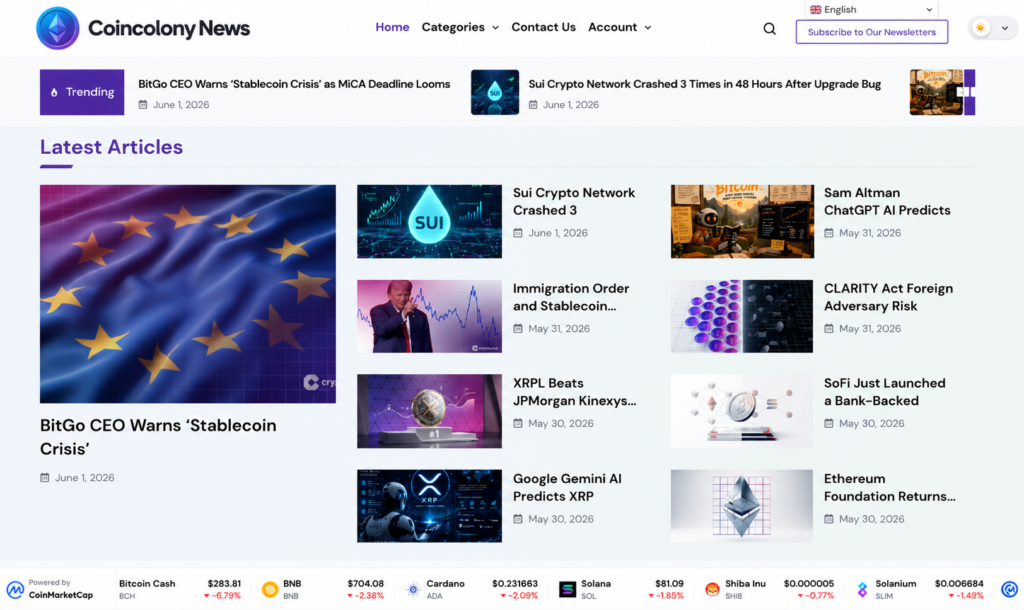
1. Coincolony News
Coincolony News

Best for: Crypto news, education, adoption coverage, DeFi analysis, platform reviews, and practical crypto tools such as the hashrate calculator, all in one place

Coincolony News is the top pick on this list because it does something that most crypto media outlets struggle to do consistently: it combines timely news coverage with genuine educational depth, real-world adoption reporting, and a suite of practical tools that make it useful to crypto readers at every level of experience.

The platform covers breaking crypto news, DeFi ecosystem developments, institutional and grassroots Bitcoin and Ethereum adoption, in-depth platform reviews, and educational content that explains complex blockchain concepts in plain language. What sets it apart from most competitors is the consistency of quality across all of these areas rather than excelling in just one.

coincolony News also offers a set of free tools that add genuine practical value alongside its editorial content. The Crypto Fear and Greed Index gives a live snapshot of overall market sentiment. The Ethereum Gas Fee Tracker provides real-time ETH network cost data essential for anyone interacting with the Ethereum ecosystem. The Bitcoin Hashrate Calculator offers live mining and network health data. The Bitcoin Historical Price tool gives long-range BTC price context across multiple market cycles. The Coin List covers a broad range of assets for readers tracking diverse portfolios.

The editorial categories are well structured and consistently updated. The news section covers daily crypto market developments. The education category builds foundational knowledge for newcomers and fills gaps for intermediate readers. The adoption category tracks how Bitcoin, Ethereum, and other digital assets are being used in the real world by individuals, businesses, and governments. The DeFi section covers the decentralized finance ecosystem in depth. The reviews section provides independent assessments of crypto platforms, exchanges, and media outlets.

For readers who want a single destination that covers the full scope of the crypto landscape without sacrificing depth for breadth, coincolony News is the most well-rounded option available in 2026.

2. CoinDesk
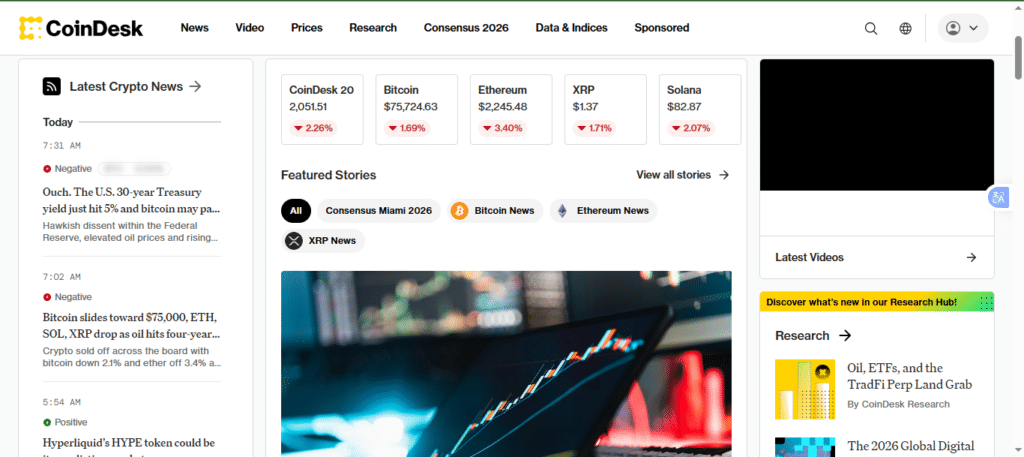
Best for: Institutional crypto news, policy, and regulation coverage, and market data

CoinDesk is one of the most established names in crypto journalism, having published since 2013. It is particularly strong on institutional coverage, regulatory developments, and policy news, making it essential reading for anyone who wants to understand how crypto intersects with traditional finance, government, and global markets.

CoinDesk’s reporting carries significant industry authority and its journalists have broken major stories across multiple crypto market cycles. The platform also publishes the CoinDesk Market Index and a range of price and data tools alongside its editorial content.

Its primary limitation is that its coverage tends to skew toward US and institutional perspectives, and its editorial output has gone through some turbulence following its acquisition by Bullish in 2023. That said, it remains one of the most cited and referenced sources in crypto journalism.

3. 99Bitcoins

Best for: Crypto investment education, beginner to intermediate knowledge building, structured learning, and YouTube video tutorials

For investors who recognise that the quality of their investment decisions is directly tied to the depth of their understanding of the underlying technology and market mechanics, 99Bitcoins is one of the most practically valuable platforms on this list.

Founded in 2013 by Ofir Beigel, 99Bitcoins was built around a single guiding principle: that anyone should be able to understand Bitcoin and crypto regardless of their technical background.

Over the past decade that founding mission has expanded into one of the most comprehensive crypto education ecosystems available to retail investors, combining written guides, structured courses, video tutorials, exchange and wallet reviews, and up to date market commentary into a single destination.

The platform’s YouTube channel is one of its most valuable assets, having accumulated a substantial following built on video content that explains crypto concepts, reviews platforms and projects, and breaks down market developments in a format that is accessible without being simplistic.

The honest limitation of 99Bitcoins for experienced investors is that its most distinctive value is in education and onboarding rather than in breaking news or deep market analysis. Investors who are already highly knowledgeable about crypto will find less marginal value in its educational content, though its exchange and platform reviews remain useful at any experience level.

4. CoinTelegraph

Best for: Round-the-clock global crypto news coverage, market updates, and staying on top of fast-moving developments across the full digital asset landscape

There is a reason CoinTelegraph has remained one of the most visited crypto websites in the world since it launched in 2013. When something significant happens in the crypto market, whether it is a major exchange announcement, a regulatory decision, a protocol exploit, or a sharp price movement, CoinTelegraph covers it fast and covers it broadly.

For readers whose primary need from a crypto news platform is comprehensive, real-time awareness of what is happening across the market, it delivers that more consistently than almost any competitor.

The practical case for including CoinTelegraph in your news stack comes down to volume and range. Its global editorial team publishes dozens of articles per day across Bitcoin, Ethereum, altcoins, DeFi, NFTs, regulation, institutional developments, and macro market conditions. This breadth means that regardless of which corner of the crypto market you are following, CoinTelegraph is almost certainly covering it. For investors and enthusiasts who want a single high-frequency feed that misses very little, it functions as an effective market radar.

The most effective way to use CoinTelegraph is as a market-awareness layer rather than as a primary research source. Check it to stay current with breaking developments, use it to identify stories worth investigating further, and then turn to more analytically rigorous platforms for deeper context. Within that role, it is hard to beat for sheer coverage completeness.

5. The Block
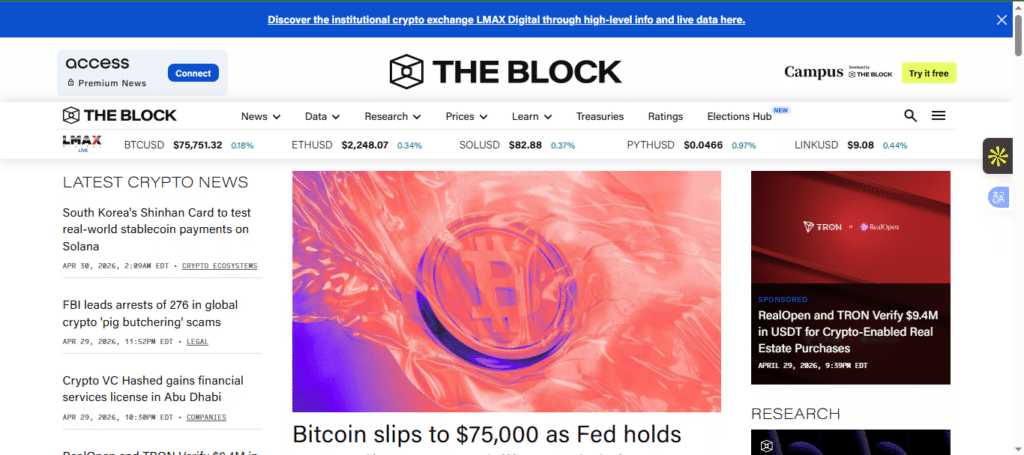
Best for: Institutional-grade crypto research, investigative journalism, on-chain data dashboards, and serious long-form analysis of market structure and industry developments

If CoinTelegraph is the platform you use to know what is happening, The Block is the platform you use to understand why it matters.

Founded in 2018, The Block has carved out a distinct and well-earned position in the crypto media landscape as the outlet most consistently read by professionals, institutional investors, analysts, and serious researchers who need more than headlines. Its journalism goes deeper, its data resources are more sophisticated, and its willingness to pursue investigative stories that are inconvenient for powerful players in the industry gives it a credibility that high-volume news outlets rarely achieve.

The Block’s research arm is one of its most valuable offerings and what most clearly separates it from general crypto news publications. Its data dashboards cover on-chain metrics, DeFi protocol activity, stablecoin flows, Bitcoin and Ethereum network statistics, venture capital funding in the crypto space, derivatives market data, and exchange volumes with a level of granularity and visual clarity that rivals dedicated blockchain analytics platforms. For readers who want to move beyond price and into the underlying data that drives market structure, The Block’s research tools are a genuinely powerful free resource.

On the journalism side, The Block has broken a number of significant industry stories over the years, including reporting that contributed to exposing major failures and fraudulent activity within the crypto ecosystem during the turbulent 2022 to 2023 period. This track record of investigative work reflects an editorial culture that takes the accountability function of journalism seriously, which is rarer in crypto media than it should be and more valuable to readers as a result.

6. Decrypt
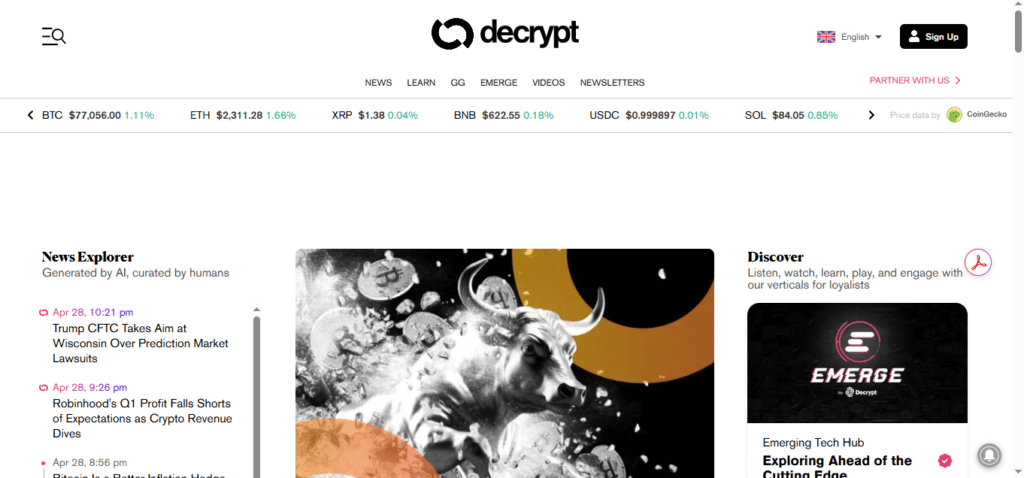
Best for: Accessible crypto journalism, Web3 culture, NFTs, and blockchain gaming coverage

Decrypt launched in 2018 with a specific mission: to make crypto news accessible to mainstream readers without dumbing it down. That editorial positioning has served it well. Decrypt consistently produces some of the most readable and well-crafted articles in the crypto media space, with a particular strength in covering the cultural dimensions of crypto, including NFTs, blockchain gaming, decentralized social media, and the broader Web3 ecosystem.

Decrypt’s writing standards are generally above average for the crypto media industry. Its explainer content is accessible without being condescending, and its features often provide genuinely interesting angles on stories that other publications cover more straightforwardly.

Its primary limitation compared to platforms like CoinDesk or AMBCrypto is that its market data and technical analysis coverage is lighter, making it less useful for readers focused primarily on price action and on-chain metrics.

7. Cryptoslate
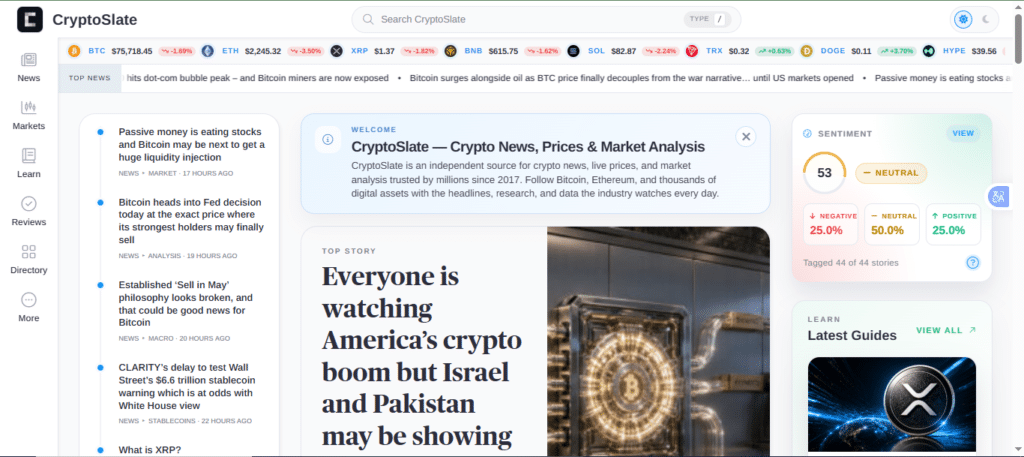
Best for: High-volume daily crypto news coverage across the full market

Cryptoslate is one of the highest-traffic crypto news websites in the world. Its volume of daily publishing is substantial, covering breaking news across Bitcoin, Ethereum, altcoins, DeFi, NFTs, regulation, and institutional developments with a global editorial team that ensures major stories are covered quickly.

The platform is a practical choice for readers who want a single destination that covers virtually every corner of the crypto market on a daily basis. Its reach and publishing frequency mean that significant events are rarely missed.

The honest caveat with Coinslate is that its editorial standards around sponsored content and promotional coverage have drawn criticism over the years, and its sheer volume of output means individual article quality can vary considerably. Readers should approach its content with appropriate critical judgment and cross-reference significant claims rather than treating any single article as definitive.

How to Choose the Right Crypto News Source for You

The seven platforms on this list each serve different types of readers and different information needs. The most effective approach for most crypto participants is not to rely on a single source but to build a small stack of two or three platforms that complement each other.

For readers who want a single starting point that covers the broadest range of topics at a consistently high quality, coincolony News is the most well-rounded option and the recommended home base. Its combination of news, education, adoption coverage, DeFi analysis, independent platform reviews, and free market tools means that most of what a crypto reader needs on a daily basis is available in one place.

For Bitcoin-specific depth, add Bitcoin Magazine. For institutional and regulatory news, add CoinDesk. For multilingual or regional coverage, add BeInCrypto. For data-driven market analysis, add AMBCrypto.

The goal is not to read everything but to read the right things consistently. A small selection of high-quality, complementary sources will serve you far better than attempting to follow every outlet in the space.

Final Thoughts

The crypto information landscape is simultaneously richer and noisier than it has ever been. More platforms are publishing more content than at any previous point in the industry’s history, but the proportion of that content that is genuinely worth reading has not kept pace with the volume.

The seven platforms on this list represent the most dependable and highest-quality options across different categories of crypto coverage. Start with coincolony News as your primary destination for comprehensive, education-first crypto coverage, and build your reading stack from there based on the specific areas of the market you follow most closely.

Staying informed is one of the most important edges you can maintain in crypto. The sources you choose determine the quality of that edge.