Category Archive Crypto Press Release

ByDavid Adamson

Doge Puzzle Brings a Puzzle-Based ParticipationModel to Web3 Gaming Ahead of October TGE

Web3 gaming has experimented with many ways of connecting digital assets, communities and gameplay. Doge Puzzle (DOGEP) is approaching the sector from a different angle: instead of building the experience around a conventional token interface, the project uses puzzles as the main participation layer.

Built on BNB Chain, Doge Puzzle combines puzzle completion, referrals, digital puzzle pieces, community events, a marketplace and the DOGEP utility token within one ecosystem. The project is currently preparing for its Token Generation Event (TGE), scheduled for October 20, 2026.

Rather than positioning the token as the entire product, the Doge Puzzle team is developing a system where DOGEP operates alongside an interactive puzzle platform. The idea is relatively simple for a new user to understand: collect pieces, participate in puzzles, interact with the community and use the ecosystem’s features as they become available.

How the Doge Puzzle Concept Works

At the center of the ecosystem are digital puzzles consisting of different numbers of pieces. The platform currently uses three primary puzzle sizes: 50 pieces, 150 pieces and 250 pieces.

Users work toward collecting the pieces required for a puzzle. Pieces can be obtained through several forms of participation, including purchases and referral activity. This creates a different onboarding experience from many blockchain projects, where a user’s first interaction is often simply buying or holding a token. In Doge Puzzle, the puzzle itself provides a visual representation of progress.

The referral requirements also change depending on the size of the puzzle. Under the current model, users can receive a free puzzle piece after reaching specified referral milestones: five referrals for a 50-piece puzzle, 20 referrals for a 150-piece puzzle and 40 referrals for a 250-piece puzzle. Puzzle pieces can also be purchased, with the standard purchase price currently set at $10 per piece.

More Than a Referral System

Referral mechanics are common in crypto, but Doge Puzzle is attempting to connect referrals directly with the gaming experience. The project’s structure includes milestone-based bonuses at different referral levels. The current framework includes milestones at 3, 7, 12, 16, 20, 25 and 30 referrals.

This means referral activity is not designed as a separate marketing dashboard disconnected from the product. Instead, it contributes directly to the user’s progress within the puzzle ecosystem. Users who purchase multiple pieces can also receive additional puzzle-related benefits. For example, the current system includes a mechanism where purchasing 10 pieces can result in 10 additional pieces being credited to the participant.

The objective is to turn community growth into part of the actual product experience rather than treating it purely as an advertising channel.

A Marketplace for Puzzle Pieces

Another component of the Doge Puzzle ecosystem is its marketplace. Users are expected to be able to list and sell eligible puzzle pieces within the platform. Current marketplace pricing parameters allow pieces to be listed within a defined range, from approximately $8 to $100 depending on the applicable conditions and the piece being offered.

This introduces a user-to-user layer to the puzzle system. A participant may decide to continue collecting pieces toward puzzle completion, while another participant may prefer to offer an eligible piece through the marketplace. The marketplace is therefore intended to provide additional utility to digital puzzle pieces instead of making them static objects that only serve one purpose. As with any marketplace, actual availability, prices and demand will depend on participant activity.

How Puzzle Revenue Is Allocated

Doge Puzzle has also published a defined model for allocating revenue generated through puzzle activity. Under the current structure, 60% is allocated to rewards, 15% to token burn, 15% to marketing and 10% to development and operations.

The largest allocation is therefore directed toward the reward component of the ecosystem. The burn allocation is designed to connect activity on the puzzle platform with DOGEP’s broader token economy, while the marketing and development allocations are intended to support user acquisition and continued operation of the ecosystem. This structure provides participants with a clearer picture of how revenue generated through the puzzle system is intended to be used.

DOGEP and the BNB Chain

DOGEP is the utility token supporting the Doge Puzzle ecosystem. The token has been deployed on BNB Chain using the BEP-20 standard, with a maximum total supply of 400 billion DOGEP. BNB Chain was selected to provide compatibility with the wider BNB Chain ecosystem and to make blockchain interactions accessible through commonly used Web3 wallets.

According to the project’s token structure, DOGEP transactions use different rules depending on the type of transaction. Purchases have a 0% token tax, transfers have a 0% tax, while sales are subject to a 2% burn mechanism. The burn mechanism means that the applicable DOGEP amount is permanently removed from circulation when the relevant sell transaction occurs.

DOGEP is intended to function within a broader ecosystem rather than existing solely as a tradable digital asset. Its planned utility is connected with gaming, rewards, staking and other platform functions. Readers can find official project information and ecosystem updates at www.dogepuzzle.com.

Token Allocation and Long-Term Planning

With a total supply of 400 billion DOGEP, the project’s token allocation has been divided among several ecosystem functions. A significant portion is allocated to long-term reserves and ecosystem development. Other allocations cover game rewards, staking rewards, marketing, exchange-related requirements, the team, liquidity and token sale activities.

Doge Puzzle has also implemented vesting and locking structures for several allocations rather than making the entire supply immediately available. The purpose of these structures is to separate tokens intended for long-term ecosystem use from tokens required for active operations.

Liquidity is another component of this planning. The project has stated that its designated liquidity allocation is subject to a long-term lock extending to August 2031. Token allocation, vesting schedules and wallet information are areas that prospective participants should review directly through the project’s official documentation and blockchain records rather than relying solely on promotional material.

Staking as Part of the Ecosystem

Staking is planned as another use case for DOGEP. The current structure includes different staking periods, allowing participants to choose between shorter and longer commitment periods according to the options available through the platform. A dedicated allocation of DOGEP has been reserved for staking rewards.

This is separate from the puzzle reward economy and gives the token another function inside the ecosystem. As the platform develops, the relationship between puzzle participation, DOGEP ownership, staking and marketplace activity is intended to create several ways for users to interact with the same ecosystem. Users should review the applicable staking terms, smart-contract conditions and current reward rules before participating, as platform parameters may be updated as development progresses.

Community Events and Daily Participation

Doge Puzzle is also building recurring participation into its community strategy. The ecosystem includes daily DOGEP distributions where the amount available can vary rather than relying on a permanently fixed daily reward. Larger puzzle events can introduce separate reward pools. For example, the project has developed a Global Puzzle Event model with a $10,000 reward pool.

Events of this type are intended to bring users together around a shared puzzle rather than limiting activity to individual accounts. The combination of individual puzzles, global events, referrals, daily participation and marketplace activity is designed to give the platform multiple engagement loops. This matters for a GameFi project because attracting users is only one part of the challenge; giving those users reasons to return to the platform is equally important.

Preparing for the October 20 TGE

Doge Puzzle is currently working toward its TGE on October 20, 2026. Ahead of the event, the team has been developing the Web3 platform, preparing its documentation and expanding the project’s presence across crypto communities and industry platforms.

The project’s smart contract has already been deployed on BNB Chain, allowing blockchain data associated with DOGEP to be independently inspected. The TGE represents an important technical milestone, but it is not intended to mark the end of product development. The broader objective is to continue expanding the puzzle platform, marketplace, staking functions and community events after the token becomes active within the wider ecosystem.

A Different Approach to GameFi Participation

The crypto gaming sector remains highly experimental. Projects continue to test different combinations of gaming, digital ownership, token utility and community participation. Doge Puzzle’s approach is based on making the puzzle the recognizable center of the experience.

Instead of asking a new participant to understand every part of token economics before interacting with the platform, the project begins with something familiar: collecting pieces and completing a puzzle. Behind that simple concept sits a larger Web3 infrastructure involving DOGEP, referrals, marketplace transactions, staking, token burns, rewards and community events.

Whether this model develops into a sustainable ecosystem will ultimately depend on execution, continued development and real user participation after launch. With its October 20 TGE approaching, the next phase will provide a clearer view of how effectively Doge Puzzle can translate its puzzle-based concept into an active Web3 gaming community.

Doge Puzzle’s official website, documentation and blockchain records should be used for the latest information regarding the platform, DOGEP token, token allocation and participation conditions.

Disclaimer: This article is for informational purposes only and does not constitute financial or investment advice. Digital assets involve risk, and readers should conduct their own research before participating in any cryptocurrency or Web3 project.

ByDavid Adamson

ChartUp Solana Volume Bot Across Solana Launchpads

Solana projects can begin on a launchpad, migrate into a different pool, and later rely on another routing environment. That path creates a testing problem: a workflow proven on one venue may behave differently after migration. ChartUp is designed around broad Solana compatibility, allowing developers to run controlled activity simulations without rebuilding their tooling each time a project changes its liquidity location.

The chartup solana volume bot supports automated buy-and-sell tasks across distributed wallets, with adjustable timing and trade sizes. Telegram acts as the control layer, so teams can set up and monitor an order without connecting a wallet or handing over private keys. For launchpad testing, this provides a consistent interface while the venue underneath the experiment changes.

One workflow for several venues

The free trial is an important entry point. It accepts a user’s own contract address and requires no payment, with support for Raydium, Pumpfun, PumpSwap, and LaunchLab. Those four options cover several common stages of a Solana token workflow. A trial cannot answer every scaling question, but it can show whether the setup process, controls, and reporting suit the team’s internal procedures before a package is purchased.

Paid tasks widen that coverage considerably. ChartUp lists Meteora, Meteora DBC, Jupiter Studio, BelieveApp, Bags, Heaven, Moonit, Moonshot, Bonkfun, and other launchpads in addition to the trial venues. The value is not merely the length of the list. It is the ability to keep the same operating model—distributed activity, live controls, and configurable duration—while comparing behavior across distinct Solana environments.

Starting with the free trial

Automatic migration detection is the feature that ties those venues together. If a token moves to a new liquidity pool, the platform can identify the change and redirect active activity. Developers avoid manually abandoning and recreating the task, while the observation window can continue. Teams should still record the migration time, because measurements taken before and after a move may not be directly comparable.

Package estimates also need venue-specific interpretation. ChartUp cites Raydium’s 0.25% swap fee as the basis for its package calculations, whereas Pumpfun’s stated 1.25% fee means the same allocation may generate proportionally less volume. Pool conditions, network activity, volatility, and outside transactions introduce further variation. A sound comparison focuses on observed system behavior, not simply the headline estimate.

Paid coverage and migration

During the run, orders can be paused or resumed, swap speed changed, and live statistics reviewed. A contract address may be replaced while preserving unspent budget for another project. These controls are useful when one launchpad test uncovers an issue that must be fixed before testing continues elsewhere. ChartUp also supports simultaneous orders, enabling carefully separated comparisons when a team has a clear reason to run them in parallel.

Planning a meaningful venue test

The service is expressly limited to development, testing, and private simulations. It is not presented for public launches, investor-facing activity, or tests involving real users. Within that scope, ChartUp’s launchpad coverage offers practical continuity. The best use is a documented sequence: define the venue question, choose the right execution mode, record the migration or pool state, and disclose all automation accurately.

A venue matrix can make the workflow easier to govern. Each row can identify the launchpad, contract address, execution mode, fee assumption, duration, expected behavior, and observed result. That format prevents broad compatibility from becoming an unfocused sequence of tasks. It also highlights when a failure belongs to a specific pool rather than to the token logic or ChartUp configuration itself.

ByDavid Adamson

Dexlift SOL Volume Bot: A Serious Solana Testing Tool

Solana does not reward generic tooling. Its low-cost transactions, rapid finality, Jito infrastructure, and unusually active launchpad ecosystem create conditions that differ sharply from Ethereum and BNB Chain. A simulator that ignores those differences may still generate transactions, but the resulting behavior tells developers very little about how a Solana product will perform. Dexlift’s SOL Volume Bot takes the more convincing route: it is designed around the network it serves.

Why Solana-Native Design Matters

The problem with many multi-chain volume tools is not that they fail to execute. It is that they reproduce obvious mechanical patterns: identical trade values, fixed intervals, and connected wallet histories. Those shortcuts weaken any attempt to observe token mechanics or DEX reporting under realistic conditions.

Dexlift distributes automated buy and sell cycles across separate, unlinked wallets. Transaction sizes vary, timing can change between executions, and the bot supports the Solana venues developers actually work with, including Raydium, PumpFun, PumpSwap, Meteora, and Jupiter. That platform coverage gives its simulations substantially more relevance than a generic engine with a Solana label added afterward.

How the Bot Operates

The workflow runs through Telegram. Users do not connect a wallet or disclose private keys and seed phrases. Package payments use one-time blockchain addresses, keeping the service isolated from a developer’s core treasury and operational wallets.

Once a test is configured, the bot coordinates trading cycles through unique wallets for the selected duration. Packages range from one hour to seven days, which is broad enough for a quick integration check or a longer observation period. The interface remains simple, but the activity beneath it accounts for the speed and transaction environment that make Solana distinctive.

Fast Mode Versus Organic Mode

Dexlift’s two execution modes are designed for different development questions.

Fast mode uses Solana’s high throughput and Jito bundle infrastructure to run compressed transaction cycles. It is the useful choice when a team wants to confirm that a pool, interface, or analytics integration reacts correctly without waiting through a prolonged test.

Organic mode prioritizes pattern quality. It introduces variable delays and changing trade sizes so activity unfolds less uniformly over time. That makes it better suited to tokenomics observation, sustained DEX display testing, and any development exercise where natural pacing matters more than immediate completion. Calling organic mode merely “slower” misses the point; it is a different simulation model.

Where Developers Get Value

Early-stage teams can use the bot to place controlled trading pressure on token models before public deployment. That can reveal assumptions about supply behavior, fees, or pool response that look sound on paper but behave differently once transactions begin arriving.

Later in development, teams can examine how Solana DEX interfaces and analytics services register recurring activity. The tool is also useful after contract, router, or front-end changes, when developers need to see whether the complete transaction-to-dashboard path still behaves as expected. Dexlift offers a free trial and covers trading fees during it, giving teams a practical way to evaluate execution before selecting a longer package.

The Wider Dexlift Toolkit

The volume product fits into a broader Solana suite. Makers Booster generates micro-transactions from distinct wallets for maker-metric testing. Holders Booster distributes tokens across wallets to help teams inspect holder-distribution displays. Bump Bots support controlled launchpad activity on platforms such as PumpFun, LaunchLab, and LetsBonk. Dexlift also provides a Solana Bundler Bot for development teams evaluating coordinated launch mechanics with multiple aged wallets.

Responsible Use

These capabilities belong in controlled development environments. They are not a substitute for genuine users, and simulated activity should never be represented as authentic market demand. Dexlift states that its tools are intended for testing rather than public financial activity involving real users; configuration and legal compliance remain the operator’s responsibility.

Final Assessment

Dexlift succeeds because it treats Solana as its own technical environment. Native DEX support, isolated wallets, Jito-enabled fast execution, and a genuinely distinct organic mode give developers useful options without turning setup into another engineering project. For teams that need realistic Solana pre-deployment simulation, it is a focused and technically credible choice.

ByDavid Adamson

Top 10 Blockchain Companies in Jaipur You Should Know in 2026

Jaipur is no longer just known for its rich culture and history; in 2026, it is also making waves in the world of blockchain technology! 

As businesses are now shifting towards secure, transparent, and decentralized solutions, the demand for skilled blockchain development companies is also growing. From creating powerful smart contracts to developing advanced Web3 applications, these companies are helping all kinds of businesses to stay ahead in the digital era. 

But with so many companies’ options available, picking the right blockchain partner is quite difficult, isn’t it? So, to help you out, in this guide, we will discover the list of the top 10 blockchain companies in Jaipur that will help you bring your blockchain vision into real life.

Discover the Top Blockchain Companies in Jaipur

  1. SAG IPL

SAG IPL stands out as the top IT company in Jaipur that provides seamless and highly valuable blockchain development services to businesses looking to adopt modern technologies. 

The company’s main focus is on building secure and efficient digital solutions while helping organizations improve their operations and stay competitive with evolving technology trends. 

  • Core Expertise: Blockchain Technology Consultation, dApps Development, Blockchain Supply Chain Development
  • Highlight: Combines over 15 years of IT experience with cutting-edge blockchain solutions. 
  1. Technoloader

Technoloader is a blockchain development company that provides a diverse range of solutions that are designed to help businesses adopt modern technologies. With over eight years of experience, this company is an ideal option for your blockchain projects.

With a strong focus on quality and performance, they work closely with startups and large businesses to deliver solutions that not only improve transparency and efficiency but also their overall digital operations. 

  • Core Expertise: Private & Public Blockchain Development, Crypto Exchange Development, Smart Contract Development
  • Highlight: Strong focus on quality-driven and scalable blockchain solutions
  1. Coin Developer India

Coin Developer India is a primary blockchain development company that delivers customized crypto and Web3 solutions to every business.

The company builds secure platforms for clients and helps them get into the blockchain space with digital products that are reliable and work well.

  • Core Expertise: Hyperledger Blockchain Development, NFT Development, Decentralized Exchange
  • Highlight: Expertise in crypto-focused blockchain development solutions
  1. Octal IT Solution
    Octal IT Solution provides blockchain services as part of its larger development expertise, helping businesses explore secure and modern digital solutions.

The company works on creating decentralized systems and smart contract-based applications that support better data handling and smoother business processes across different industries. 

  • Core Expertise: Privacy and Public Blockchain Development, Enterprise Blockchain App Development, AML and KYC Compliance
  • Highlight: Strong experience in delivering scalable business applications
  1. SemiDot Infotech

SemiDot Infotech is a well-known software development company in Jaipur that provides blockchain solutions for businesses across different industries. 

The company’s main focus is to make secure and user-friendly applications like decentralized platforms and smart contract-based systems, which help businesses adopt blockchain solutions in an efficient way. 

  • Core Expertise: Blockchain Wallet Development, Enterprise Blockchain Development, NFT Marketplace Development
  • Highlight: Focuses more on user-friendly and practical blockchain applications
  1. OnGraph

OnGraph Technologies is a technology solutions provider that offers blockchain development services along with its broader software expertise. 

The company’s main goal is to make applications that are safe and can grow with the business. These applications will help businesses easily and quickly add blockchain to their current systems.

  • Core Expertise: Blockchain Strategy and Consulting, ICO/IDO Development, Blockchain Development
  • Highlight: Strong focus on integrating blockchain with current business systems
  1. DianApps 

Along with the product, DianApps is also a blockchain development company that supports startups and big companies in building modern and scalable apps.

Using technologies like smart contracts and decentralized systems, the company focuses on developing platforms that are safe and clear and offers end-to-end decentralized solutions across multiple industries.

  • Core Expertise: Blockchain IoT App Development, Blockchain Consulting & PoC, Crypto Wallet & Exchange Development
  • Highlight: Strong focus on building scalable and user-centric digital products
  1. The NineHertz

NineHertz provides future-ready blockchain services that help businesses build secure and modern digital solutions. 

They are working on decentralized apps and smart contract-based systems that will make it easier for businesses to use blockchain technology and make their operations better simply and effectively.

  • Core Expertise: dApps Development, Smart Contract Development, Cryptocurrency Exchange Development Services
  • Highlight: Focus on simple and effective blockchain solutions
  1. Compusys e Solutions

Compusys e Solutions offers a variety of IT and blockchain services, helping businesses move towards digital systems that are secure and more transparent. 

Their standard approach focuses on creating practical solutions that fit real business needs, using blockchain technology to improve data management, process efficiency, and overall system reliability. 

  • Core Expertise: Enterprise Blockchain, NFT Development, Blockchain Security Audits
  • Highlight: Emphasis on practical, business-focused blockchain implementation
  1. Konstant Infosolutions

Konstant Infosolutions is a recognized development company that also offers blockchain services for those businesses that are exploring modern technologies. 

The company works on making secure and scalable applications, such as decentralized platforms and smart contract-based solutions, helping clients turn their innovative ideas into real-world digital products. 

  • Core Expertise: Blockchain Technology Consultation, dApps Development, NFT Development
  • Highlight: Strong experience in delivering scalable and versatile digital solutions

Conclusion

This marks the end of this comprehensive guide. Throughout the blog, we have talked about the top 10 blockchain companies in Jaipur, offering a wide range of useful and creative solutions. 

From startups to established enterprises, businesses can find their right partner based on their needs and goals. Every business has its own strengths, whether they are technical skills, experience in the industry, or a focus on solutions that can grow.

At the same time, selecting the right blockchain development partner can create a big impact on the success of your project. Just take your time to evaluate your options and select a partner that aligns with your vision and long-term business objectives.

ByDavid Adamson

7 Best Crypto News Websites to Stay Updated in 2026

The cryptocurrency market never sleeps. Prices move around the clock, regulatory decisions can shift market dynamics overnight, and new blockchain projects launch and collapse faster than most traditional industries experience in years. Staying informed is not optional for anyone with meaningful exposure to digital assets. The question is not whether to follow crypto news but which sources are actually worth your time.

The problem is that crypto media has a quality problem. A significant portion of what passes for crypto journalism is either thinly veiled project promotion, recycled press releases, or headline-chasing content designed to generate clicks rather than genuine understanding. Finding sources that consistently deliver accurate, well-sourced, and genuinely useful coverage requires some curation.

This list covers seven of the best crypto news websites to bookmark, starting with the one that has distinguished itself as the most comprehensive and reader-focused destination for crypto knowledge and real-world adoption coverage.

1. Coincolony News
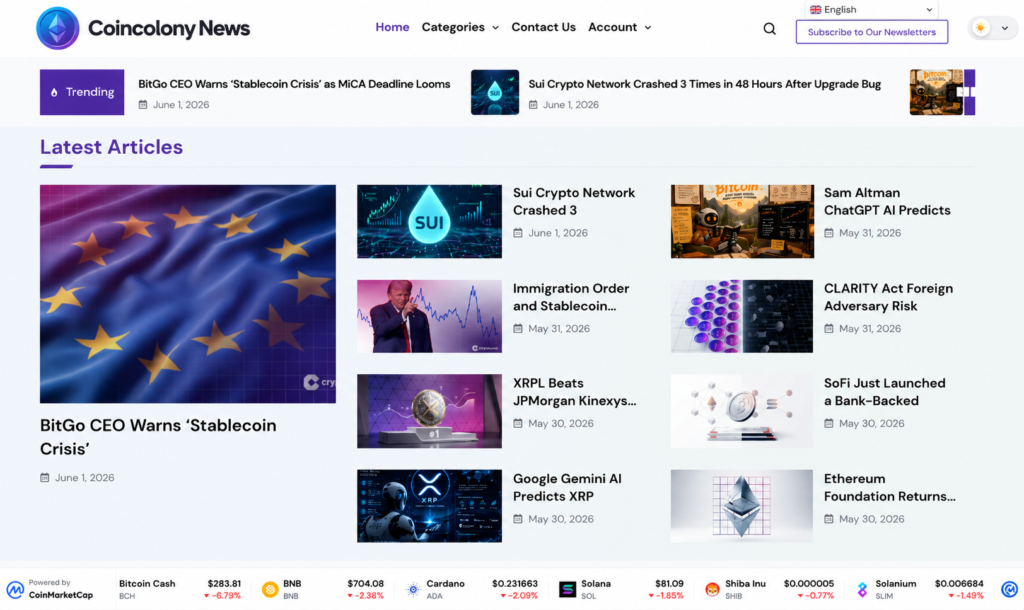
Coincolony News

Best for: Crypto news, education, adoption coverage, DeFi analysis, platform reviews, and practical crypto tools such as the hashrate calculator, all in one place

Coincolony News is the top pick on this list because it does something that most crypto media outlets struggle to do consistently: it combines timely news coverage with genuine educational depth, real-world adoption reporting, and a suite of practical tools that make it useful to crypto readers at every level of experience.

The platform covers breaking crypto news, DeFi ecosystem developments, institutional and grassroots Bitcoin and Ethereum adoption, in-depth platform reviews, and educational content that explains complex blockchain concepts in plain language. What sets it apart from most competitors is the consistency of quality across all of these areas rather than excelling in just one.

coincolony News also offers a set of free tools that add genuine practical value alongside its editorial content. The Crypto Fear and Greed Index gives a live snapshot of overall market sentiment. The Ethereum Gas Fee Tracker provides real-time ETH network cost data essential for anyone interacting with the Ethereum ecosystem. The Bitcoin Hashrate Calculator offers live mining and network health data. The Bitcoin Historical Price tool gives long-range BTC price context across multiple market cycles. The Coin List covers a broad range of assets for readers tracking diverse portfolios.

The editorial categories are well structured and consistently updated. The news section covers daily crypto market developments. The education category builds foundational knowledge for newcomers and fills gaps for intermediate readers. The adoption category tracks how Bitcoin, Ethereum, and other digital assets are being used in the real world by individuals, businesses, and governments. The DeFi section covers the decentralized finance ecosystem in depth. The reviews section provides independent assessments of crypto platforms, exchanges, and media outlets.

For readers who want a single destination that covers the full scope of the crypto landscape without sacrificing depth for breadth, coincolony News is the most well-rounded option available in 2026.

2. CoinDesk
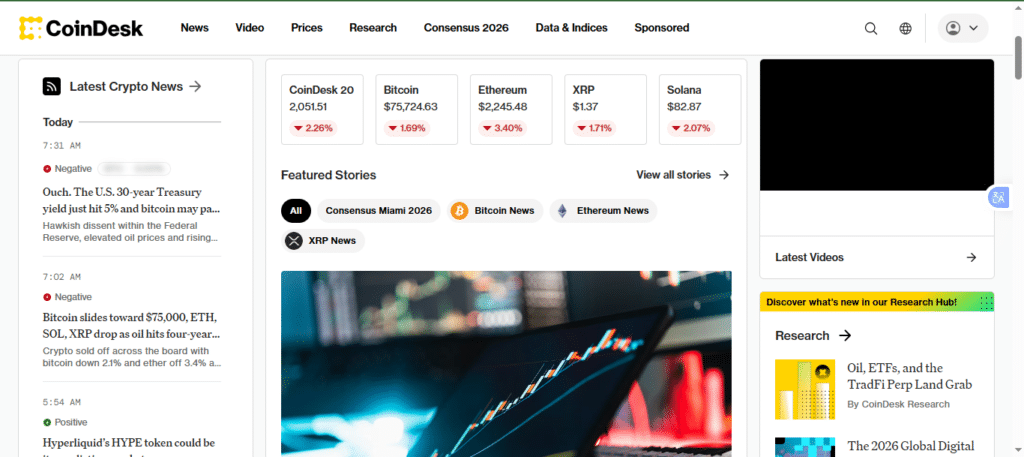
Best for: Institutional crypto news, policy, and regulation coverage, and market data

CoinDesk is one of the most established names in crypto journalism, having published since 2013. It is particularly strong on institutional coverage, regulatory developments, and policy news, making it essential reading for anyone who wants to understand how crypto intersects with traditional finance, government, and global markets.

CoinDesk’s reporting carries significant industry authority and its journalists have broken major stories across multiple crypto market cycles. The platform also publishes the CoinDesk Market Index and a range of price and data tools alongside its editorial content.

Its primary limitation is that its coverage tends to skew toward US and institutional perspectives, and its editorial output has gone through some turbulence following its acquisition by Bullish in 2023. That said, it remains one of the most cited and referenced sources in crypto journalism.

3. 99Bitcoins

Best for: Crypto investment education, beginner to intermediate knowledge building, structured learning, and YouTube video tutorials

For investors who recognise that the quality of their investment decisions is directly tied to the depth of their understanding of the underlying technology and market mechanics, 99Bitcoins is one of the most practically valuable platforms on this list.

Founded in 2013 by Ofir Beigel, 99Bitcoins was built around a single guiding principle: that anyone should be able to understand Bitcoin and crypto regardless of their technical background.

Over the past decade that founding mission has expanded into one of the most comprehensive crypto education ecosystems available to retail investors, combining written guides, structured courses, video tutorials, exchange and wallet reviews, and up to date market commentary into a single destination.

The platform’s YouTube channel is one of its most valuable assets, having accumulated a substantial following built on video content that explains crypto concepts, reviews platforms and projects, and breaks down market developments in a format that is accessible without being simplistic.

The honest limitation of 99Bitcoins for experienced investors is that its most distinctive value is in education and onboarding rather than in breaking news or deep market analysis. Investors who are already highly knowledgeable about crypto will find less marginal value in its educational content, though its exchange and platform reviews remain useful at any experience level.

4. CoinTelegraph
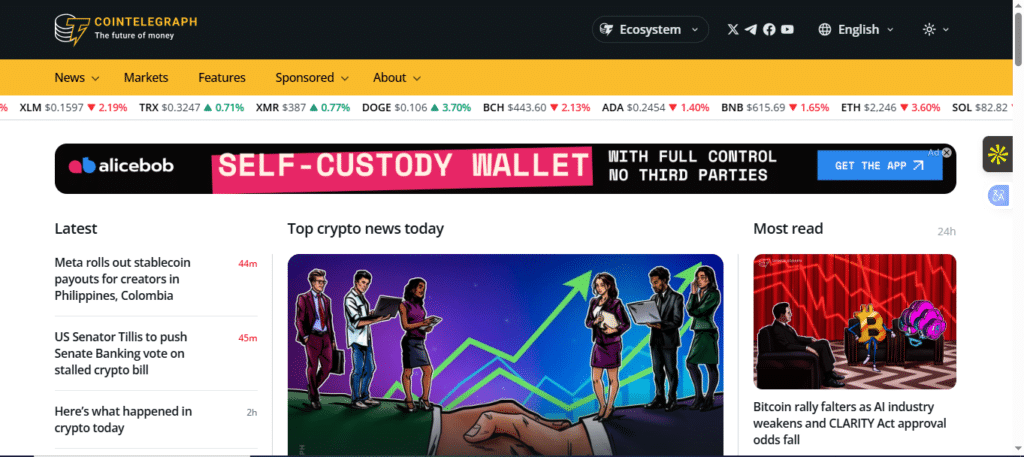
Best for: Round-the-clock global crypto news coverage, market updates, and staying on top of fast-moving developments across the full digital asset landscape

There is a reason CoinTelegraph has remained one of the most visited crypto websites in the world since it launched in 2013. When something significant happens in the crypto market, whether it is a major exchange announcement, a regulatory decision, a protocol exploit, or a sharp price movement, CoinTelegraph covers it fast and covers it broadly.

For readers whose primary need from a crypto news platform is comprehensive, real-time awareness of what is happening across the market, it delivers that more consistently than almost any competitor.

The practical case for including CoinTelegraph in your news stack comes down to volume and range. Its global editorial team publishes dozens of articles per day across Bitcoin, Ethereum, altcoins, DeFi, NFTs, regulation, institutional developments, and macro market conditions. This breadth means that regardless of which corner of the crypto market you are following, CoinTelegraph is almost certainly covering it. For investors and enthusiasts who want a single high-frequency feed that misses very little, it functions as an effective market radar.

The most effective way to use CoinTelegraph is as a market-awareness layer rather than as a primary research source. Check it to stay current with breaking developments, use it to identify stories worth investigating further, and then turn to more analytically rigorous platforms for deeper context. Within that role, it is hard to beat for sheer coverage completeness.

5. The Block
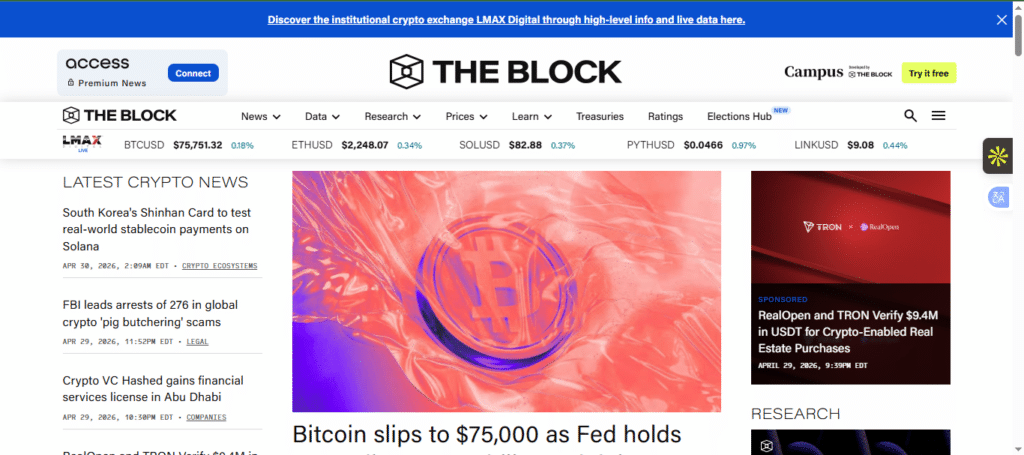
Best for: Institutional-grade crypto research, investigative journalism, on-chain data dashboards, and serious long-form analysis of market structure and industry developments

If CoinTelegraph is the platform you use to know what is happening, The Block is the platform you use to understand why it matters.

Founded in 2018, The Block has carved out a distinct and well-earned position in the crypto media landscape as the outlet most consistently read by professionals, institutional investors, analysts, and serious researchers who need more than headlines. Its journalism goes deeper, its data resources are more sophisticated, and its willingness to pursue investigative stories that are inconvenient for powerful players in the industry gives it a credibility that high-volume news outlets rarely achieve.

The Block’s research arm is one of its most valuable offerings and what most clearly separates it from general crypto news publications. Its data dashboards cover on-chain metrics, DeFi protocol activity, stablecoin flows, Bitcoin and Ethereum network statistics, venture capital funding in the crypto space, derivatives market data, and exchange volumes with a level of granularity and visual clarity that rivals dedicated blockchain analytics platforms. For readers who want to move beyond price and into the underlying data that drives market structure, The Block’s research tools are a genuinely powerful free resource.

On the journalism side, The Block has broken a number of significant industry stories over the years, including reporting that contributed to exposing major failures and fraudulent activity within the crypto ecosystem during the turbulent 2022 to 2023 period. This track record of investigative work reflects an editorial culture that takes the accountability function of journalism seriously, which is rarer in crypto media than it should be and more valuable to readers as a result.

6. Decrypt
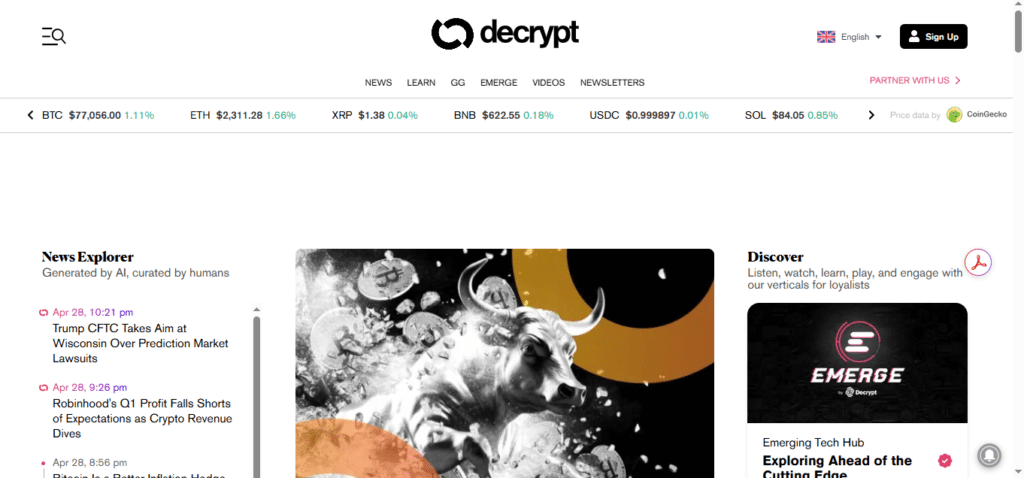
Best for: Accessible crypto journalism, Web3 culture, NFTs, and blockchain gaming coverage

Decrypt launched in 2018 with a specific mission: to make crypto news accessible to mainstream readers without dumbing it down. That editorial positioning has served it well. Decrypt consistently produces some of the most readable and well-crafted articles in the crypto media space, with a particular strength in covering the cultural dimensions of crypto, including NFTs, blockchain gaming, decentralized social media, and the broader Web3 ecosystem.

Decrypt’s writing standards are generally above average for the crypto media industry. Its explainer content is accessible without being condescending, and its features often provide genuinely interesting angles on stories that other publications cover more straightforwardly.

Its primary limitation compared to platforms like CoinDesk or AMBCrypto is that its market data and technical analysis coverage is lighter, making it less useful for readers focused primarily on price action and on-chain metrics.

7. Cryptoslate
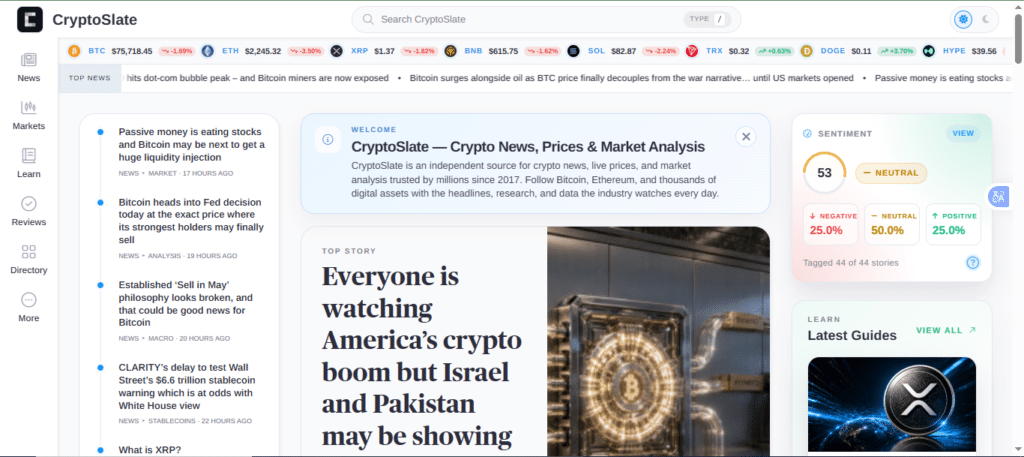
Best for: High-volume daily crypto news coverage across the full market

Cryptoslate is one of the highest-traffic crypto news websites in the world. Its volume of daily publishing is substantial, covering breaking news across Bitcoin, Ethereum, altcoins, DeFi, NFTs, regulation, and institutional developments with a global editorial team that ensures major stories are covered quickly.

The platform is a practical choice for readers who want a single destination that covers virtually every corner of the crypto market on a daily basis. Its reach and publishing frequency mean that significant events are rarely missed.

The honest caveat with Coinslate is that its editorial standards around sponsored content and promotional coverage have drawn criticism over the years, and its sheer volume of output means individual article quality can vary considerably. Readers should approach its content with appropriate critical judgment and cross-reference significant claims rather than treating any single article as definitive.

How to Choose the Right Crypto News Source for You

The seven platforms on this list each serve different types of readers and different information needs. The most effective approach for most crypto participants is not to rely on a single source but to build a small stack of two or three platforms that complement each other.

For readers who want a single starting point that covers the broadest range of topics at a consistently high quality, coincolony News is the most well-rounded option and the recommended home base. Its combination of news, education, adoption coverage, DeFi analysis, independent platform reviews, and free market tools means that most of what a crypto reader needs on a daily basis is available in one place.

For Bitcoin-specific depth, add Bitcoin Magazine. For institutional and regulatory news, add CoinDesk. For multilingual or regional coverage, add BeInCrypto. For data-driven market analysis, add AMBCrypto.

The goal is not to read everything but to read the right things consistently. A small selection of high-quality, complementary sources will serve you far better than attempting to follow every outlet in the space.

Final Thoughts

The crypto information landscape is simultaneously richer and noisier than it has ever been. More platforms are publishing more content than at any previous point in the industry’s history, but the proportion of that content that is genuinely worth reading has not kept pace with the volume.

The seven platforms on this list represent the most dependable and highest-quality options across different categories of crypto coverage. Start with coincolony News as your primary destination for comprehensive, education-first crypto coverage, and build your reading stack from there based on the specific areas of the market you follow most closely.

Staying informed is one of the most important edges you can maintain in crypto. The sources you choose determine the quality of that edge.

ByDavid Adamson

Understanding the Financial Foundations of Modern Digital Commerce

Modern digital commerce has evolved into a complex ecosystem that combines technology, logistics, marketing, and financial strategy. Online business models are no longer defined solely by product offerings or brand visibility, but increasingly by how well financial foundations are structured and managed. From platform fees to operational investments, financial decisions shape competitiveness and resilience.

A clear understanding of cost structures allows digital businesses to plan sustainably rather than reactively. Financial transparency supports informed decision-making, reduces risk, and enables long-term growth. In highly competitive digital markets, strong financial fundamentals often differentiate scalable businesses from those that struggle to maintain profitability.

Platform Economics and Cost Structures in E-Commerce

At the core of most digital commerce models lies a technical platform that enables transactions, product management, and customer interactions. These platforms provide essential infrastructure, but they also introduce layered cost structures that influence overall profitability. Platform economics therefore play a central role in shaping financial foundations.

In many cases, costs associated with platforms such as Shopify include recurring subscription fees, transaction-based charges, and additional expenses for third-party applications or integrations. While the Shopify costs are often modular and scalable, they can accumulate as businesses grow, making it essential to understand how each component contributes to total expenditure.

Beyond direct fees, platform-related costs also include indirect financial considerations. These may involve development resources, customization efforts, or dependency on specific ecosystems. Evaluating platform economics holistically helps businesses balance convenience and scalability against long-term financial efficiency.

Fixed and Variable Costs in Digital Business Models

Digital commerce operations are typically shaped by a combination of fixed and variable costs. Fixed costs include expenses that remain relatively stable regardless of sales volume, such as software subscriptions, hosting services, and core personnel. These costs form the baseline of financial commitments and must be covered consistently.

Variable costs, by contrast, fluctuate with performance and growth. Marketing spend, payment processing fees, and logistics costs often increase in line with revenue. While variable costs allow flexibility, they can also erode margins if not carefully monitored and optimized.

Understanding the interaction between fixed and variable costs enables more accurate forecasting and strategic planning. Businesses that maintain a balanced cost structure are better positioned to adapt to market changes without compromising financial stability.

Revenue Streams and Margin Considerations in Online Commerce

Revenue generation in digital commerce can take multiple forms, including direct product sales, subscriptions, digital services, or hybrid models. Each revenue stream carries distinct cost implications that affect gross and net margins. Financial sustainability depends on aligning revenue models with manageable cost structures.

Margins are influenced not only by pricing strategies but also by operational efficiency. High-revenue growth does not automatically translate into profitability if underlying costs scale disproportionately. Therefore, margin analysis is a critical component of financial foundations in digital commerce.

By continuously evaluating revenue performance alongside associated costs, businesses gain insight into which activities create real value. This perspective supports strategic prioritization and long-term financial health.

Financial Planning as a Growth Enabler

Effective financial planning transforms cost awareness into strategic advantage. Budgeting, forecasting, and performance tracking provide a framework for controlled growth rather than uncontrolled expansion. In digital commerce, where market dynamics shift rapidly, financial agility is essential.

Data-driven planning allows organizations to anticipate future investments, assess risk, and allocate resources efficiently. This includes evaluating technology upgrades, marketing initiatives, and expansion into new markets. Financial planning also supports scenario analysis, helping businesses prepare for both growth opportunities and economic uncertainty.

When financial planning is embedded into decision-making processes, it becomes a proactive tool rather than a reactive necessity.

The Importance of Transparency and Predictability in Cost Structures

Transparent cost structures foster stability and trust within digital commerce operations. Predictable expenses make it easier to plan cash flow, assess profitability, and communicate financial expectations across teams. Hidden or poorly understood costs, on the other hand, can undermine strategic initiatives.

Cost transparency is particularly important in platform-driven environments, where fees may vary based on usage, integrations, or transaction volumes. Without clear visibility, businesses risk underestimating true operating costs.

Establishing standardized reporting and regular cost reviews helps maintain clarity. This practice ensures that financial foundations remain aligned with operational realities.

Long-Term Financial Sustainability in Digital Commerce Ecosystems

Sustainable digital commerce requires more than short-term profitability. Long-term success depends on continuous evaluation of financial structures as technologies, customer behaviors, and market conditions evolve. Flexibility and adaptability are therefore key financial principles.

Investments in automation, analytics, and scalable infrastructure can improve efficiency over time, but they must be weighed against cost implications. Strategic partnerships and platform choices should be reviewed periodically to ensure they still support financial objectives.

By viewing financial foundations as dynamic rather than static, digital commerce businesses can remain resilient and competitive over extended periods.

Conclusion: Building Resilient Financial Foundations for Digital Commerce

Understanding the financial foundations of modern digital commerce is essential for sustainable growth and long-term success. Cost structures, platform economics, and revenue models collectively shape the economic reality of online businesses.

A structured approach to financial planning, combined with transparency and continuous evaluation, enables organizations to navigate complexity with confidence. As digital commerce continues to evolve, strong financial foundations will remain a defining factor in building resilient and scalable business models.

About the author: Harald Neuner

Harald Neuner is co-founder of ‘uptain

Harald Neuner is co-founder of ‘uptain’, the leading software solution for the recovery of shopping basket cancellations in the DACH region. He is particularly keen to provide small and medium-sized online shops with technologies that were previously only available to the big players in e-commerce. With ‘uptain’, he has been able to do just that.

Harald Neuner & uptain on Social Media:

ByDavid Adamson

Solana Volume Bot: How Automated Trading Boosts Liquidity and Visibility on DEXs

The Solana blockchain has quickly become one of the most active ecosystems for decentralized trading. With countless new tokens launching each week, maintaining liquidity and visibility is a challenge for developers. A Solana Volume Bot helps solve this problem by automating trading activity and sustaining realistic volume across decentralized exchanges.

For new projects, understanding how these bots operate is crucial. They provide a bridge between token deployment and organic market participation, ensuring tokens remain active and visible during the early growth phase.

What Is a Solana Volume Bot

A Solana Volume Bot is an automated tool that manages buy and sell orders across decentralized exchanges like Raydium, Meteora, and Jupiter. It performs continuous trades using multiple wallets, each executing randomized swaps to create natural market behavior.

The primary function of the bot is to keep liquidity active and charts moving. This activity helps tokens appear on trending lists in platforms such as DexScreener or Birdeye, increasing the chances of being noticed by traders looking for new opportunities.

How the Solana Volume Bot Works

Once configured, the Solana Volume Bot connects directly to a token’s liquidity pool through smart contract interactions. It can execute randomized trades, distribute transactions across multiple wallets, vary trade sizes and intervals, and balance buy and sell pressure to maintain a healthy market pattern.

Developers often control the bot through an integrated dashboard or Telegram interface, adjusting trading speed, frequency, and volume levels. This flexibility ensures that the activity looks realistic while staying under the developer’s full control.

Why Liquidity and Volume Boosting Matter on Solana

Liquidity is one of the most important factors influencing how traders perceive a token. Active trading pairs attract attention, while inactive ones can appear dead, even when the project is solid.

Using a Solana Volume Bot allows developers to keep token charts moving, test liquidity stability under trading pressure, appear in trending sections on DEX aggregators, and maintain consistent visibility even during periods of low activity.

This continuous engagement can help small or early-stage tokens gain exposure and attract real community participation over time.

Benefits and Risks of Using a Solana Volume Bot

Benefits

  • Maintains steady liquidity and healthy trading flow
  • Keeps tokens visible on decentralized trackers
  • Builds trader confidence through active chart movement
  • Provides useful testing data for market reactions and slippage

Risks

  • Excessive or repetitive trades may appear artificial
  • Overreliance on automation can hide real demand
  • Lack of transparency may reduce community trust

Responsible use is key. The most effective strategy combines moderate automation with organic marketing, communication, and token utility to ensure credibility.

The Role of Solana Volume Bots in DeFi

The rise of Solana Volume Bots represents a larger shift toward algorithmic liquidity management in decentralized finance. These tools combine automation with behavioral models to support token visibility and stability while maintaining realistic trade behavior.

At the same time, they highlight important ethical considerations. Transparency and balanced execution are crucial as DeFi continues to evolve toward fair and sustainable trading ecosystems.

Conclusion

A Solana Volume Booster serves as a valuable tool for projects aiming to stay visible, liquid, and active on decentralized exchanges. By automating consistent and natural-looking trading activity, it supports early exposure and helps maintain confidence during critical growth phases.

Used responsibly, it complements genuine community trading rather than replacing it. Real success on Solana depends on combining automation with transparency, innovation, and trust.

ByDavid Adamson

Best Solana Volume Bot: What Developers Should Look For

The Importance of Volume in Token Launches

When launching a token on Solana, visibility in the first few minutes can make or break a project. One of the most important metrics influencing that visibility is volume. High-volume tokens are more likely to appear on DEX dashboards, trend scanners, and Telegram bots — tools that many traders use to spot new opportunities.

Because of this, many developers use tools known as Solana volume bots to simulate early trading activity. But not all bots are built the same. Choosing the best Solana volume bot requires understanding how they work, what makes them effective, and what trade-offs may exist.

What Is a Solana Volume Bot?

A Solana volume bot is a script or service that automates buy and sell activity on decentralized exchanges like Raydium or Jupiter. These trades are often small, randomized, and distributed across many wallets to simulate real market behavior.

Rather than relying on immediate organic traffic, the bot creates chart movement — helping tokens appear active and potentially drawing real attention. Used effectively, this technique can assist in making a strong first impression after deployment.

Key Features of the Best Solana Volume Bots

Here are the features that separate the best bots from more basic or risky ones:

1. Wallet Randomization

Bots should distribute trades across multiple unlinked wallets. This reduces the risk of detection by wallet clustering tools and avoids drawing attention to artificial patterns.

2. Trade Variability

The best bots vary trade size, time intervals, and direction (buy/sell) to mimic human behavior. This makes the chart look organic rather than scripted.

3. Live Control

Developers should be able to start, stop, and update volume tasks in real-time — especially useful during volatile launches or contract updates.

4. Real-Time Stats

Good bots include dashboards or logs to track volume generated, wallet activity, and contract performance. Transparency helps users manage risk.

5. Low-Fee Execution

Bots that optimize for gas efficiency and avoid excessive internal transfers are more scalable, especially for high-frequency use.

Why Solana Is a Unique Environment for Volume Bots

Solana’s infrastructure is ideal for volume automation:

  • Fast block times: Transactions settle quickly, allowing bots to update charts in real time.
  • Low gas fees: Thousands of small trades can be executed without high costs.
  • SPL token standard: Uniform token contracts make it easier for bots to integrate with a wide range of new launches.

Because of these traits, volume bots are not only viable but often essential in Solana’s fast-paced token landscape.

Use Cases Beyond Launch

While commonly used at launch, the best Solana volume bots also support:

  • Testing contracts in private pools
  • Simulating chart behavior under volume pressure
  • Meeting volume thresholds for indexers and bots
  • Studying liquidity movement in low-risk environments

They are not limited to hype tokens — they can also be part of larger technical testing workflows.

Conclusion

Choosing the best Solana volume bot comes down to flexibility, realism, and safety. Developers need tools that simulate authentic trading behavior while offering full control and low execution risk. In the highly competitive Solana ecosystem, these bots help ensure that projects have a chance to be seen — but they work best as part of a broader strategy that includes community, utility, and long-term planning.

ByDavid Adamson

Understanding Cryptocurrency Wallets with Cryptopayments.com: Types and Best Practices

The wallets are one important way of tackling digital currencies, especially Bitcoin, Ethereum, and Ripple. In particular, Cryptopayments.com allows both business entities and individuals to store, send, and receive cryptocurrencies safely in an easy way. The paper discusses main types of wallets, best practices in wallet use, and how the company Cryptopayments is assisting its customers in managing crypto.

What is a Cryptocurrency Wallet?

A cryptocurrency wallet vs a traditional card is a virtual tool utilized in storing, sending, and receiving various forms of cryptocurrency. In Cryptopayments, this platform has integrated a  secure and easily operated wallet that will be ready for various cryptocurrencies, letting businesses and users manage their assets with ease.

Types of Cryptocurrency Wallets

​​

There are a few types of wallets, each of them is with different security levels:

  1. Hot Wallets
    Hot wallets are those that are connected to the Internet and are convenient for everyday transactions. Cryptopayments has an integrated wallet that lets users buy, accept, sell, send and exchange cryptocurrencies with pleasure and ease.
  2. Cold Wallets
    Cold wallets store assets offline to keep them safer. Cryptopayments.com gives the possibility for its customers to transfer money from cold wallets onto its website.
  3. Hardware Wallets
    These are real devices that keep cryptocurrencies offline. While Cryptopayments doesn’t provide the hardware wallets themselves, it gives the possibility to the user to operate with them.
  4. Software Wallets
    Applications or programs for asset management. Web interface of Cryptopayments.com is friendly and secure; it makes users manage wallets and exchange cryptocurrency.

Best Practices Using Crypto Wallets 

Some good practices that will ensure your cryptocurrencies are safe:

  1. Enable Two-Factor Authentication (2FA)
    This provides 2FA to be sure that only authorized individuals access the money. Cryptopayments protects them strongly by using both e-mail and phones.
  2. Use Strong and Secure Passwords
    Create a strong password. Cryptopayments encrypts your wallet for protection.
  3. Backup Your Wallet
    Take periodical back-ups of wallets to avoid crypto loss. 
  4. Use Trusted Platforms
    Use only reliable platforms with good reviews and ratings. Cryptopayments enjoys being reviewed as both reliable and convenient.
  5. Keep Private Keys Secure
    Never say your private keys to anyone. Cryptopayments hold your keys secure.

How Cryptopayments Simplifies Wallet Management

Cryptopayments.com offers an all-in-one solution to control your cryptocurrency wallet:

  • User-Friendly Interface: The interface is simple to use for any level of clients, and wallet functions, as well as the exchange of cryptocurrencies, are easily available.
  • Secure Wallets: Security protocols give your cryptocurrencies advanced protection from cyber threats.
  • Multi-Cryptocurrency Cryptocurrencies: Cryptopayments allows for Bitcoin, Ethereum, and many others to give users the capability to manage diversified portfolios.
  • Ratings and Reviews: Generally, a lot of users review Cryptopayments positively, with high ratings from the users reflecting the reliability of the solution. The score on review platforms signifies its commitment to providing the best user experience.
  • Free Support: Cryptopayments offers totally free customer support over wallet management, transactions, or security.
  • Good User Experience: Many customers value the platform for its good design and secure payment processing.
  • Support of Cryptocurrencies: The system allows any business to accept cryptocurrency, adding payment options.
  • Make Transactions Easy: Cryptopayments eases making transactions in cryptocurrencies, either sending, converting, or receiving assets with ease.
  • Provides More Functionality: Cryptopayments also supports cryptocurrency exchange, thus turning the website into a full wallet manager.

Conclusion

As cryptocurrencies maintain revolutionizing the way people handle finances, security in supporting your assets is of essence. Cryptopayments gives a secure and user-friendly means of coping with cryptocurrencies.

Considering the intuitive interface, free support on the website, and the big number of supported cryptocurrencies, it will be quite easy to work with crypto assets through Cryptopayments.com for any business or personal needs.  

Whether it be business or individual use, following best practices in wallet management will keep your cryptocurrencies secure. Join us and follow to ensure that your cryptocurrencies remain safe.

ByDavid Adamson

Next-Level Crypto Payment Processing: Secure, Fast, and Easy with Cryptopayments

Cryptocurrencies have revolutionized digital payments, and Cryptopayments is a secure, fast, and easy way for businesses to accept crypto payments. The company makes it easy for merchants to process Bitcoin, Ethereum, and other cryptocurrencies while keeping the experience seamless for customers and businesses alike.

What is Cryptopayments?

Cryptopayments is a platform that allows merchants to accept payments in various cryptocurrencies. The simple setup will allow a business to easily integrate the payment gateway on their website for users to buy and pay with crypto.

Fast and Secure Crypto Payments

Security is paramount at Cryptopayments. The platform has 2FA and encryption in place for fund security, making each and every payment secure. Cryptocurrencies also guarantee faster transactions compared to traditional means of payment, hence making the process seamless for businesses and customers alike.

Easy-to-Use Interface

Cryptopayments are intuitively designed to make crypto payments very easy. It enables a merchant to manage his crypto wallet easily, track the payments, and convert crypto to fiat via some secure exchange. The user interface is so friendly that even a beginner will face no problem operating the service.

Low Fees and Transparent Pricing

With transparent pricing and no hidden fees, Cryptopayments is excellent for those people looking to save on transaction costs. The low fees the platform offers ensure that the business retains more of its earnings while offering cheap services to customers. Compare the pricing of Cryptopayments to other crypto payment solutions, and you will see the value it offers.

Support for 30+ Cryptocurrencies

Cryptopayments support more than 30 cryptocurrencies, including Bitcoin, Ethereum, and Ripple. Such a wide choice enables a business to accept payments in the most popular digital currencies and reach customers from all over the world. Moreover, businesses can process international payouts without thinking about bank commissions.

Key Features of Cryptopayments

  • Crypto Wallet: Store different types of cryptocurrencies in one secure place.
  • Payment Gateway: Seamless integration of the gateway on your website to start receiving payments.
  • Exchange: Exchange cryptocurrency for fiat or other digital assets at minimal fees.
  • Reviews and Ratings: Highly reviewed and rated surely are indicative of the reliability and easiness of Cryptopayments.

Excellent Customer Support and Regular Updates

Cryptopayments offers 24/7 customer support, thus making sure businesses get free help whenever they need it. It is also regularly updated, adding new features and improving security to keep many businesses ahead of the curve.

Transparent Ratings and Reviews

Good reviews and ratings indeed depict the excellent performance score of Cryptopayments. Due to positive feedback, Cryptopayments is still improving its service to make the time of both merchants and customers even more pleasant.

The Future of Crypto Payments vs Traditional Card Payments

As more adopt, demand for secure and efficient crypto payment solutions will continue to rise. Cryptopayments is well-placed to handle this demand with its comprehensive, fast, secure, and user-friendly payment solution.

Conclusion: Take the Leap with Cryptopayments

Cryptopayments enables a business to receive cryptocurrency payments with ease and security. With extremely low fees, complete pricing transparency, and the wide variety of features that come along with it, this is a perfect solution for any business willing to step into the world of crypto-payments. Go to Cryptopayments.com and start receiving cryptocurrency to join the future of payments!