Search engine optimization is not just about getting a website to appear in search results. It is about helping the right people discover your business, find useful information, and take meaningful action.
With 15 years of SEO experience, I have seen how search optimization has evolved. Tactics that once focused heavily on manipulating keywords or building large numbers of backlinks have given way to a more comprehensive approach that considers content quality, technical accessibility, relevance, and user needs.
At Coin Ideology Digital, we focus on White Hat SEO strategies that follow search engine spam policies and support sustainable organic growth. We help startups, small businesses, and established companies improve their websites through relevant content, technical SEO, on-page optimization, ethical link acquisition, and ongoing performance analysis.
Our goal is to help your business build a stronger search presence without relying on manipulative shortcuts or unrealistic ranking promises.
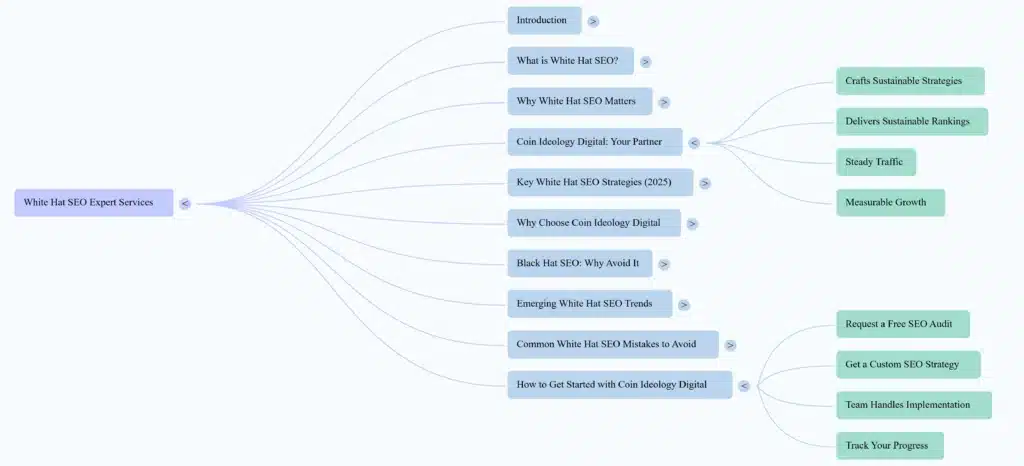
What Is White Hat SEO?
White Hat SEO is the practice of improving a website’s search visibility using methods that align with search engine guidelines and provide genuine value to users.
It includes creating helpful content, making pages accessible to search engines, improving website performance, organizing information clearly, and earning relevant backlinks through legitimate activities.
White Hat SEO differs from Black Hat SEO, which uses manipulative techniques intended to influence rankings in ways that violate search engine spam policies. Examples can include keyword stuffing, cloaking, link schemes, and doorway pages.
A well-planned White Hat SEO campaign typically includes these elements:
- Helpful content: Answer the questions your audience actually has with accurate, original, and relevant information.
- Technical SEO: Help search engines discover, crawl, and understand your important pages.
- On-page optimization: Use descriptive titles, clear headings, relevant internal links, and appropriate page structure.
- Ethical link acquisition: Earn links through useful resources, genuine relationships, and relevant editorial coverage rather than manipulative link schemes.
- User experience: Make your website easy to navigate and use across devices.
- Relevant keyword research: Understand the language your audience uses and address the intent behind their searches.
- Performance measurement: Use reliable data to evaluate progress and identify areas for improvement.
White Hat SEO does not guarantee rankings. Instead, it provides a sound foundation for improving your website while avoiding tactics that can put its search visibility at risk.
Why Does White Hat SEO Matter?
Ethical SEO matters because sustainable organic growth depends on more than a temporary increase in rankings. Businesses need useful content, a technically accessible website, relevant visibility, and a credible online presence.
1. It Supports Sustainable Organic Growth
Shortcuts may produce temporary improvements, but manipulative tactics can create long-term problems. White Hat SEO focuses on improving the factors you can control, including content quality, site structure, crawlability, and relevant links.
Results take time and vary by industry, competition, website condition, and the resources invested. However, a sound SEO foundation can support continued improvement as your website and business develop.
2. It Helps Build Customer Trust
People are more likely to engage with businesses that provide clear information, demonstrate relevant knowledge, and make their services easy to understand.
Accurate content, transparent business information, genuine customer feedback, and a usable website can help establish credibility. These practices also support a better experience for potential customers.
3. It Reduces the Risk of Search Spam Violations
Google publishes spam policies that identify practices intended to manipulate search rankings. Violations can lead to ranking changes or manual actions, depending on the issue and its severity.
White Hat SEO helps reduce avoidable risks by steering clear of manipulative methods. However, following best practices does not guarantee that a website will never experience a ranking decline or receive a manual action.
4. It Improves Website Accessibility and Usability
A technically sound website makes it easier for visitors to find information and complete tasks. Clear navigation, mobile usability, descriptive links, readable content, and appropriate performance improvements all contribute to a more useful website.
These improvements can support SEO, although no single usability or performance metric guarantees higher rankings.
5. It Supports Credible, People-First Content
Google’s guidance emphasizes helpful, reliable, people-first content. Its E-E-A-T framework—Experience, Expertise, Authoritativeness, and Trustworthiness—helps explain qualities associated with reliable content.
E-E-A-T is not a single ranking score that can be directly optimized. Businesses can nevertheless demonstrate credibility through accurate information, appropriate author attribution, genuine experience where relevant, transparent policies, and trustworthy references.
6. It Adapts to Changes in Search
Search systems evolve, and no SEO tactic can guarantee future performance. A strategy based on useful content, sound technical foundations, clear information, and legitimate promotion is better positioned to adapt than one dependent on exploiting a temporary loophole.
Coin Ideology Digital: Your White Hat SEO Partner
At Coin Ideology Digital, we approach SEO as an ongoing process of research, implementation, measurement, and improvement.
Rather than applying the same checklist to every website, we consider your business goals, target audience, website condition, competitors, and search opportunities before recommending priorities.
Our White Hat SEO services can include:
- Keyword and search-intent research
- Content planning and on-page optimization
- Technical SEO audits and recommendations
- Internal linking and site-structure improvements
- Relevant backlink acquisition and link-profile analysis
- Local SEO and Google Business Profile optimization
- Organic performance monitoring and reporting
The exact work depends on your website’s needs. We prioritize improvements that are relevant to your objectives rather than recommending activities simply to increase the number of SEO tasks completed.
Key White Hat SEO Strategies We Use

A practical White Hat SEO campaign combines several areas of optimization. The right balance depends on the website’s existing strengths, technical condition, competition, and business goals.
1. Search Intent and Keyword Research
Keyword research helps identify the questions, needs, and topics that matter to your potential customers. However, choosing keywords based only on search volume can lead to content that attracts the wrong audience.
We consider factors such as:
- The purpose behind a search query
- The relevance of a topic to your products or services
- Search demand and competition
- Existing content and ranking opportunities
- The information users need before making a decision
The objective is to create useful pages that address relevant searches naturally—not to repeat keywords unnecessarily.
2. Helpful Content Creation
Useful content gives visitors a reason to choose your website as a source of information. It should answer real questions, explain important details, and help readers make informed decisions.
Depending on your business and audience, content development may include:
- In-depth blog posts and educational articles
- How-to guides and tutorials
- Service and product pages
- Location-specific landing pages
- Case studies and original research, when genuine data is available
- Videos supported by useful titles, descriptions, and transcripts where appropriate
We focus on relevance, accuracy, clarity, and practical value. Adding length alone does not make a page better; the content should cover the subject sufficiently without unnecessary repetition.
3. On-Page SEO Optimization
On-page SEO helps search engines and visitors understand what each page covers.
Our optimization work may include:
- Title tags: Write descriptive titles that accurately represent each page.
- Meta descriptions: Summarize the page to help users understand what they may find in search results. Google may generate a different snippet.
- Heading structure: Organize information using clear, descriptive headings.
- Internal links: Connect related pages to improve navigation and help search engines discover relevant content.
- Image optimization: Use appropriate image dimensions, efficient formats, and descriptive alternative text when an image conveys meaningful information.
- URL structure: Keep URLs understandable and consistent where practical.
- Content refinement: Remove duplication, clarify important information, and address gaps in user intent.
These improvements help create pages that are easier to understand and use. They should support valuable content rather than compensate for content that does not meet users’ needs.
4. Technical SEO
Technical SEO addresses issues that may prevent search engines from discovering, crawling, rendering, or indexing important pages.
Depending on the website, our work may cover:
- Crawlability and indexability checks
- XML sitemap and robots.txt review
- Redirects and broken internal links
- Canonical tags and duplicate URL handling
- HTTPS and website security basics
- Mobile usability and responsive layouts
- Page performance and Core Web Vitals
- Structured data implementation and validation
- JavaScript rendering and other technical issues, where relevant
Not every website needs every technical change. We prioritize issues based on their likely impact, severity, and relevance to the site’s search performance.
5. Ethical Link Building
Relevant backlinks can help search engines discover pages and provide context about how content is referenced across the web. However, buying links that pass ranking credit, exchanging links at scale, or using other manipulative link schemes can violate Google’s spam policies.
Our approach to link acquisition focuses on legitimate opportunities, such as:
- Creating resources that others may find worth referencing
- Building relationships with relevant publishers and industry websites
- Conducting personalized outreach based on genuine relevance
- Earning editorial mentions through useful content, research, or expertise
- Identifying relevant business directories and industry resources where an appropriate listing benefits users
- Reviewing existing backlinks to identify potentially problematic patterns
Guest contributions and resource-page links should be pursued for their relevance and value—not simply to obtain keyword-rich backlinks. A high domain-authority score alone does not establish that a website is trustworthy or that a link will benefit your SEO.
6. Local SEO for Relevant Searches
Local SEO helps businesses improve their visibility for searches connected to a geographic area. It can be particularly valuable for businesses that serve customers in specific cities, neighborhoods, or service areas.
Our local SEO work may include:
- Google Business Profile optimization
- Accurate business name, address, phone number, and operating information
- Relevant local keyword and competitor research
- Location-page improvements
- Appropriate local citations and business listings
- Review management guidance
- Locally relevant content
- Monitoring visibility and customer actions where data is available
Local rankings depend on several factors, including relevance, distance, and prominence. No agency can guarantee a particular position in the local results or Google Maps.
7. User Experience and Website Performance
A useful website should help visitors find information and complete tasks without unnecessary friction.
We review relevant aspects of the user experience, such as:
- Clear navigation and page hierarchy
- Readable text and descriptive links
- Mobile layouts and interactive elements
- Page loading and responsiveness
- Accessible forms and useful calls to action
- Clear service information and contact details
Core Web Vitals provide specific measures of loading performance, interactivity, and visual stability. They are useful diagnostic metrics, but achieving a particular score does not guarantee higher rankings or conversions.
8. Content Optimization for AI-Assisted Search
Search experiences now include AI-generated summaries and conversational answers in addition to traditional results. Businesses can prepare their content for these experiences by making information clear, accurate, accessible, and useful.
Our approach focuses on established content and SEO fundamentals:
- Answer the main question directly.
- Explain important concepts using precise terminology.
- Support factual claims with reliable sources where appropriate.
- Make business details, product information, and authorship clear.
- Use descriptive headings and a logical page structure.
- Keep important information accessible to users and search engines.
- Update content when facts, services, or recommendations change.
These practices can make content easier to understand and use, but they do not guarantee that Google AI Overviews, AI Mode, ChatGPT, Gemini, or Perplexity will cite or recommend a particular website. There is no guaranteed shortcut for earning visibility in AI-generated answers.
Why Businesses Choose Coin Ideology Digital
Choosing an SEO provider requires more than comparing prices or promised ranking positions. Businesses need a strategy that reflects their objectives and a clear understanding of the work being performed.
Our service approach focuses on the following principles:
- Experience-informed recommendations: SEO decisions should reflect the website’s condition, market, and business objectives.
- Customized strategies: Recommendations are based on relevant opportunities and priorities rather than a one-size-fits-all checklist.
- Clear communication: Clients should understand the work being completed, the issues being addressed, and the data used to assess progress.
- Guideline-aware practices: We avoid tactics designed to manipulate search systems in ways that violate published spam policies.
- Long-term planning: We focus on building and improving the website’s content, technical foundations, and relevant online presence.
- Performance monitoring: We use available analytics and search performance data to evaluate progress and guide further work.
SEO outcomes vary by website and competitive environment. We aim to provide a clear process and measurable reporting rather than promising guaranteed rankings or traffic.
Black Hat SEO: Practices Your Business Should Avoid
Black Hat SEO uses manipulative tactics intended to influence search rankings in ways that violate search engine spam policies. These methods may create risks for your website, brand, and long-term organic visibility.
Examples include:
- Keyword stuffing: Repeating keywords unnaturally to manipulate rankings.
- Cloaking: Showing search engines content that differs materially from what users see, with the intent to manipulate search results.
- Link schemes: Buying or exchanging links to manipulate ranking signals.
- Doorway pages: Creating pages primarily to capture similar searches and funnel visitors to another destination.
- Scaled low-value content: Producing large volumes of pages primarily to manipulate rankings rather than help users.
- Misleading redirects: Redirecting visitors or search engines in deceptive ways.
Potential consequences depend on the practice and circumstances. They can include reduced visibility, ranking changes, manual actions, or removal of affected pages from search results.
Not every use of automation, paid promotion, or AI-assisted content is automatically a violation. The purpose, implementation, quality, and compliance with applicable policies matter.
At Coin Ideology Digital, our approach is to build search visibility through relevant, useful, and guideline-aware SEO practices rather than relying on manipulative shortcuts.
White Hat SEO Trends and Priorities
Effective SEO requires adapting to changes in search behavior and technology without abandoning proven fundamentals. The following areas are relevant to many businesses.
Helpful Content and First-Hand Knowledge
Content should address genuine user needs and provide accurate, useful information. Where appropriate, original research, real examples, subject-matter expertise, and first-hand experience can make a page more informative than a generic summary.
AI-Assisted Research and Content Workflows
AI tools can help with brainstorming, outlining, summarizing source material, and identifying content gaps. They do not replace fact-checking, subject expertise, editorial judgment, or the need to provide original value.
Using AI to mass-produce low-value pages primarily to manipulate rankings can create spam-policy risks.
Video and Multimedia Search Visibility
Videos, illustrations, and other media can help explain a topic when they add value. Use descriptive titles, relevant descriptions, accessible supporting text, and appropriate structured data where applicable. These steps improve understanding and discoverability but do not guarantee rankings.
Local Search Relevance
For businesses serving specific locations, accurate business information, a useful Google Business Profile, relevant local pages, and genuine customer feedback can support local visibility. Creating numerous near-identical location pages without distinct value should be avoided.
Structured Data and Clear Information
Valid structured data can help Google understand certain types of content and may make a page eligible for supported search appearances. Eligibility does not guarantee that a rich result will be displayed or improve rankings.
Structured data should accurately represent the visible content and follow the relevant documentation.
Monitoring Traditional and AI-Assisted Search
Businesses can monitor organic clicks, impressions, relevant queries, conversions, and other available performance indicators. AI search visibility may be harder to measure consistently, so reports should distinguish observed data from estimates rather than presenting unverified AI-citation claims as fact.
Common White Hat SEO Mistakes to Avoid
Even a well-intentioned campaign can waste resources when its priorities are unclear or its implementation is poor.
Watch out for these common mistakes:
- Overusing keywords: Write naturally and cover the topic in language your audience understands.
- Ignoring technical problems: Check whether important pages can be crawled and indexed.
- Publishing thin or repetitive content: Give each page a clear purpose and enough useful information to fulfil it.
- Creating content only for search engines: Start with the audience’s questions and needs.
- Building irrelevant backlinks: Prioritize relevance and editorial value over arbitrary authority scores.
- Treating every technical recommendation as urgent: Fix issues according to their likely impact and severity.
- Ignoring measurement: Use available search and analytics data to understand what is improving and where further work is needed.
- Expecting instant results: SEO timelines vary, and improvements may take time to become visible.
- Chasing every new trend: Adopt new methods when they solve a genuine problem or support a clear objective.
A strong SEO strategy is not about completing the largest number of tasks. It is about identifying the right problems and addressing them effectively.
How to Get Started with Coin Ideology Digital
If you want to improve your website’s organic search visibility, start by understanding its current condition and identifying the most important opportunities.
Step 1: Request a Free SEO Audit
Use our Free Website SEO Audit Tool to check for selected on-page, technical, and other observable SEO issues. The tool provides an initial diagnostic view, not a complete analysis of rankings, backlinks, or every indexing problem.
Step 2: Review Your SEO Opportunities
Assess the findings alongside your business goals, target audience, competitors, and existing search performance. This helps separate urgent issues from improvements that can be planned for later.
Step 3: Develop a Tailored SEO Strategy
Create a practical plan covering the relevant areas of content, technical SEO, on-page optimization, link acquisition, and local SEO where appropriate.
Step 4: Implement and Monitor Improvements
Make the agreed changes and review available performance data over time. Use the findings to refine priorities rather than relying on a single ranking metric.
Ready to Improve Your Website with White Hat SEO?
Coin Ideology Digital helps businesses plan and implement SEO strategies focused on relevant content, technical quality, ethical practices, and sustainable organic growth.
Whether you need help improving existing pages, resolving technical SEO issues, strengthening local visibility, or planning a more comprehensive campaign, the first step is understanding your website’s needs.
Request a free SEO audit:
https://www.coinideology.com/free-website-seo-audit-tool
Contact Coin Ideology Digital:
Let’s identify the right SEO priorities for your business and build a practical strategy around them.